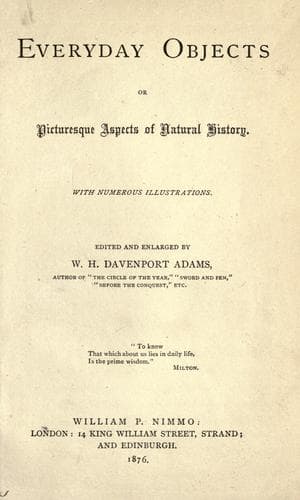
Everyday Objects; Or, Picturesque Aspects of Natural History.Adams, W. H. Davenport (William Henry Davenport)
History
Everyday Objects; Or, Picturesque Aspects of Natural History.
Adams, W. H. Davenport (William Henry Davenport)
Natural history
Simultaneously with the discovery of the variations of the solar
charioteer, it was ascertained that the moments of the sun's passage
of the meridian--moments which measure the 365 different positions
occupied by the sun in the 365 days of the year--are not separated by
equal intervals, or that equal intervals of time do not correspond
to the equal angular displacements,--in fine, that the maximum and
minimum of the sun's angular velocity coincide with the maximum and
minimum of its apparent diameter. Now, remember that the extreme
points where the sun experiences its maximum and minimum angular
displacement are named, according to Ptolemæus, the former the
_perigee_, the latter the _apogee_; or, if we follow Copernicus, the
former the _perihelion_, and the latter the _aphelion_.
The aggregate of these facts was known to the ancients; but the
manner in which it was sought to explain them merits notice as a
specimen of blind attachment to a preconceived system.
Ptolemæus, the organ of the dictatorial astronomy of antiquity,
declares, _ex cathedrâ_, that "the inequalities of the sun's
movements are only apparent; that they are simply the effects of
the position and of the arrangements of the circles in which these
movements are accomplished; and that, in this _apparent disorder of
the phenomena_ (περί τὴν ὑπονουμένην τῶν
φαινομένων ἀταξίαν), nothing really occurs contrary
to their actual immobility (τῷ ὄντι πέφυκε
συμβαίνειν οὐδὲν ἀλλότριον αὐτῶν
τῆς ἀΐδιοτητος)."
Now, according to this dogmatic immutability, the straight lines, or
radii, which proceed from the revolving star to the centre of the
circle, would describe "equal angles in equal times." This is exactly
the contrary of the result obtained, as we have seen, by careful
observation.
But this difficulty no more embarrassed the great pontiff of
astronomy than a conscientious scruple would perplex the author of a
theological dogma. Listen to him:--
"The true cause of these apparent irregularities is explained by two
very simple hypotheses. Either the one or the other would account
for the phenomena. In fact, if we suppose the movement to occur in
a circle described around the centre of the world, and in the plane
of the ecliptic, so that the point whence we are looking corresponds
with this centre, we must admit either that the planets make their
movements equal in non-concentric circles, or that, if these circles
are concentric, it is not simply in these circles that they move, but
in others, called _epicycles_, carried through the concentric."[73]
Public-domain text, read in full here on John Shaqi.
Reviews
Reviews
No reviews yet
Be the first to share your thoughts on this work.
Elsewhere in the archive
Join the Discussion
Join the discussion
Sign in to leave a comment or review.
Sign InorCreate an account