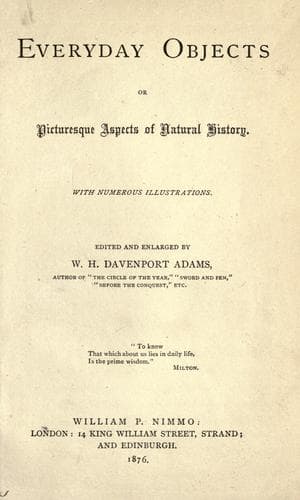
Everyday Objects; Or, Picturesque Aspects of Natural History.Adams, W. H. Davenport (William Henry Davenport)
History
Everyday Objects; Or, Picturesque Aspects of Natural History.
Adams, W. H. Davenport (William Henry Davenport)
Natural history
[Footnote 75: Kepler, "Astronomia Nova, seu de Motibus Stellæ
Martis," p. 53 (ed. 1609).]
[Footnote 76: The reader should turn to Kepler's immortal work, "De
Motibus Stellæ Martis," for the manifold attempts of the astronomer
to bring calculation into agreement with observation. In every page
is revealed what has been finely called "the passionate patience of
genius."]
[Footnote 77: There is certainly no exaggeration in comparing the
earth to a point, since the diameter of the sun is 112 times that
of the earth, and its mean distance a little more than 12,000
terrestrial diameters: the earth is but a microscopical point
in space, if we compare it to the place occupied by the central
luminary.]
[Illustration]
CHAPTER II.
_WHAT MAY BE SEEN UPON THE EARTH._
"I care not, Fortune, what you me deny;
You cannot rob me of free Nature's grace;
You cannot shut the windows of the sky
Through which Aurora shows her bright'ning face;
You cannot bar my constant feet to trace
The woods and lawns by living streams at eve."
[Illustration]
Of all the strata composing our planetary mass, the most important,
so far as man is concerned, is, at the same time, the most
superficial; for it is here that all the phenomena of life transpire.
Our vegetable earth is the great laboratory in which are prepared all
the solid, liquid, and gaseous aliments necessary for the nourishment
of animal life. It is on the surface of the globe that men play
their various parts. And why? Can it be for no other purpose than to
modify, in some degree, its aspect, that they occupy the terrestrial
surface? One would be tempted to think so on consulting what these
majestic _bimanes_ pompously designate their "Universal History."
Regions formerly blooming with fertility,--gay with gardens, and
orchards, and meadows,--musical with brooks, and glorious with
harvest,--are now uncultivated and barren. Monuments which seemed
adapted to defy the winds and the rains, and the corroding touch of
the years, lie shattered in ruins; and with them the once populous
cities and the once mighty empires of which they were the pride. The
jackal howls among the broken columns of Tadmor; the sand-drifts have
accumulated above the splendour of Memphis and Thebes. With their
stones other monuments are raised, other cities are embellished, and
other empires, which, in their turn, undergo the same unalterable
fate: a perpetual relation of human forms, in every respect
comparable with that which transpires in the bosom of the prolific
earth, our common mother and nurse.
Public-domain text, read in full here on John Shaqi.
Reviews
Reviews
No reviews yet
Be the first to share your thoughts on this work.
Elsewhere in the archive
Join the Discussion
Join the discussion
Sign in to leave a comment or review.
Sign InorCreate an account