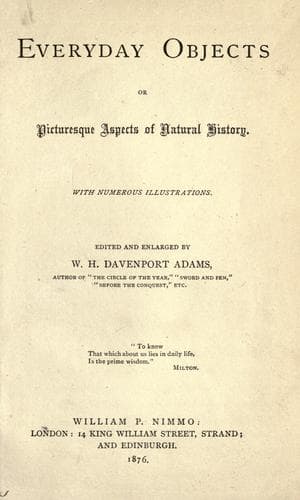
Everyday Objects; Or, Picturesque Aspects of Natural History.Adams, W. H. Davenport (William Henry Davenport)
History
Everyday Objects; Or, Picturesque Aspects of Natural History.
Adams, W. H. Davenport (William Henry Davenport)
Natural history
The uppermost stratum of our globe undergoes the direct action of
the light and heat of the all-vivifying "orb of day." This action,
very unequal in its effects, and most important to understand, has
scarcely been touched as yet by scientific research. Our geologists,
having been more busily engaged with the inside than the outside
of the earth, have broached certain plausible theories--for the
most part of a very dubious character--respecting the central fire,
Plutonism and Neptunism, the stratification of the planets, the
formation of mountains, valleys, and basins. Our mineralogists,
thinking far less of the chemical molecular constitution of the
different formations than of their crystalline constitution, have
minutely studied the physical qualities and geometrical forms of the
integral parts of the rocks; but neither have condescended to direct
their inquiries to the layer of soil trodden underneath their feet.
Yet this very layer of arable earth, to which all bodies must return
after death what they have taken from it during life,--this much
despised _humus_, furnishes all our agricultural products, the very
foundation and support of our material existence.
To touch industrial occupations--to meddle with trade, commerce, or
agriculture--is unworthy of Science! Such is the silly cry of the
many distinguished savants who pride themselves on what they call
their "freedom from selfish considerations."
Be it so; but then you ought surely to be consistent, and never
regard science as a profession or a bread-winner.
ON THE CHEMICAL ACTION OF LIGHT.
It is no easy study to investigate the modifications and chemical
effects which the terrestrial surface is capable of receiving or
undergoing, either from the direct rays of the sun, or from diffused
light. It requires new methods of inquiry,--methods frequently
of extreme delicacy, as the labours of Bunsen and Roscoe, of
Kirchhofer and Tyndall, have abundantly demonstrated. Let us here
confine ourselves to establishing the fact that the chemical action
of light varies according to the geological constitution of the
soil,--according to the diurnal and annual obliquity of the solar
rays,--according to the hours of the day,--according to the latitudes
and seasons. The maximum of effects is manifested about the times of
the solstices.
For the better co-ordination of these phenomena, might we not, as has
been done in regard to the distribution of heat over the terrestrial
surface,[78] link together by lines the points of equality? We should
thus create an aggregate of _iso-photo-chemical_ lines,--diurnal,
mensual, and annual,--of incontestible utility for the progress of
general physics and meteorology, which are still in their infancy.
But to realise this magnificent programme, the union and agreement is
necessary of scientific men in every region of the globe; an ideal,
therefore, as yet, is very far from being attained.
THE ACTION OF HEAT.
Public-domain text, read in full here on John Shaqi.
Reviews
Reviews
No reviews yet
Be the first to share your thoughts on this work.
Elsewhere in the archive
Join the Discussion
Join the discussion
Sign in to leave a comment or review.
Sign InorCreate an account