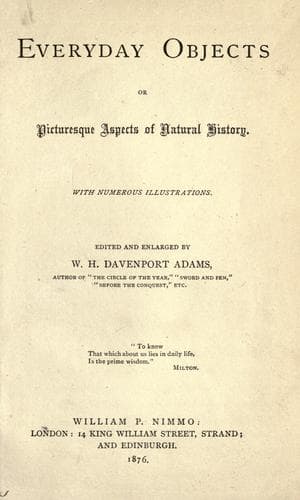
Everyday Objects; Or, Picturesque Aspects of Natural History.Adams, W. H. Davenport (William Henry Davenport)
History
Everyday Objects; Or, Picturesque Aspects of Natural History.
Adams, W. H. Davenport (William Henry Davenport)
Natural history
I had much difficulty to get one of the sufferers, who was sixty
years old, to swallow the first few spoonfuls. He was plunged into
a lethargic insensibility differing in no respect from complete
apoplexy; his teeth were closely set. Those whom I had ordered
to administer the mixture had given it up, after several useless
attempts; and in all probability the old man would have sunk, had I
not had the patience to hold, for some hours, against his teeth the
back of the blade of a small silver knife, so as to profit by the
few moments when the teeth were a little less firmly clenched. I
used some force to make the blade act as a wedge, and after a while
opened up a passage to the handle, which, serving as a lever, forced
the jaws sufficiently apart to admit the introduction of a spoonful
of the emetic. It was not, however, until fully two hours had passed
that the patient, having undoubtedly swallowed the necessary dose,
began to vomit, with strenuous efforts and frightful cries. This
was at midnight. Four in the morning arrived before, after numerous
alternations of vomiting and profound lethargy, he began to speak,
and then like a man in delirium. After the first vomit, which was
inconsiderable, the convulsions of his whole body were so very
violent as to require four men to hold him, while I continued to make
use of my knife as at first. Nor did I desist until I was satisfied
that his stomach had been sufficiently cleansed. After this, I
applied two strong blisters to the back of his legs. As these acted,
the purging subsided, and at the end of twenty-four hours it had
passed away entirely, the invalid finding himself as well as could
be expected after sustaining so severe a shock. The other patients,
who were not in so much danger, experienced twitchings and tremblings
in the face, which quite disfigured them; the brain seemed a blank;
though awake, they felt as in a dream, and their visions were most
frightful.
It is evident, from these particulars, that mushroom-poisoning
specially affects the encephalic nervous system, and that the best
remedies are emetics and antispasmodics. In our present ignorance of
what are the poisonous principles in the _Amanita_, we can adopt no
other method than a chemical neutralisation.
AGARICUS CÆSAREUS, OR IMPERIAL MUSHROOM.
Public-domain text, read in full here on John Shaqi.
Reviews
Reviews
No reviews yet
Be the first to share your thoughts on this work.
Elsewhere in the archive
Join the Discussion
Join the discussion
Sign in to leave a comment or review.
Sign InorCreate an account