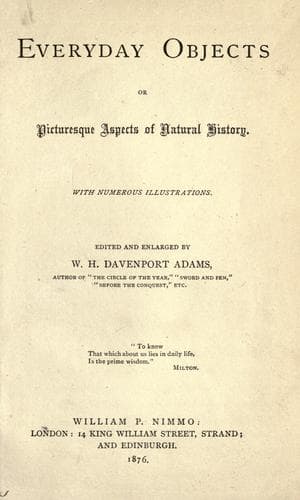
Everyday Objects; Or, Picturesque Aspects of Natural History.Adams, W. H. Davenport (William Henry Davenport)
History
Everyday Objects; Or, Picturesque Aspects of Natural History.
Adams, W. H. Davenport (William Henry Davenport)
Natural history
If we admit that the other orders of insects, the Lepidoptera, the
Hemiptera, the Hymenoptera, the Neuroptera, the Orthoptera, the
Diptera, the Strepsiptera, comprise, taken altogether, at least the
same number of species as the Coleoptera alone, we shall gain, for
the class of insects, a total of 200,000. And we shall certainly
keep within the truth if we assign the same number of species to
the Annelida, the Crustacea, the Arachnida, the Myriapoda, and the
Monomorpha, to which, with some modification, we may apply the
remarks already called forth by the Coleoptera.
Let us recapitulate. The four classes of _Vertebrate Animals_ include
approximatively:--
1,600 species Mammals.
5,000 " Birds.
2,000 " Reptiles.
12,000 " Fishes.
------
20,600
If we add to these 20,600 species of Vertebrate Animals, 200,000
species of Articulata, and 22,000 Mollusca (a minimum), we shall have
a total of 242,600.
But to complete the grand whole of beings "who grow, and live,
and feel" (the definition of animals laid down by Linnæus), we
must add the Intestinal Worms, the Echinodermata, the Acalephæ
(or Sea-nettles), and the Polypes. The history of these singular
creatures, which apparently form the transition between the animal
and vegetable kingdom, and have thence been designated _Zoophytes_,
leaves much, very much, to be desired before it will be possible to
indicate, even approximatively, the number of their species.
* * * * *
And, finally, what shall we say of the Infusoria? These microscopic
forms of life seem, by their extreme multiplicity, to animate
all nature. It is in studying these that the inquirer needs to
be constantly on his guard, that he may not mistake transitory
conditions--or larvæ--for actual species, and it behoves him to
understand thoroughly the difficult delimitation of specific
characters. It would be far easier to ascertain the exact number of
human beings who at present people the terrestrial surface, than to
fix the total of the species of Infusoria now in existence; assuredly
it exceeds 250,000. What an infinite variety of design is here! What
a picture it presents of the inexhaustibility of the Creative Mind!
* * * * *
Add, then,--let us say, in conclusion,--to this last great total the
aggregate of the Vertebrates, the Articulates, and the Molluscs, and
for our grand whole we have a minimum of _half a million_ of ANIMAL
SPECIES! This is the very figure, observe, at which we arrived as
representing the lowest limit of the totality of VEGETABLE SPECIES,
living and moving, flourishing, and dying, and reproducing, on the
surface of the globe.
We leave the reader to meditate--as meditate he surely must--on the
sublime thoughts, the overpowering ideas of Power and Wisdom which
these considerations suggest.
WHAT IS CHLOROPHYLL?
Public-domain text, read in full here on John Shaqi.
Reviews
Reviews
No reviews yet
Be the first to share your thoughts on this work.
Elsewhere in the archive
Join the Discussion
Join the discussion
Sign in to leave a comment or review.
Sign InorCreate an account