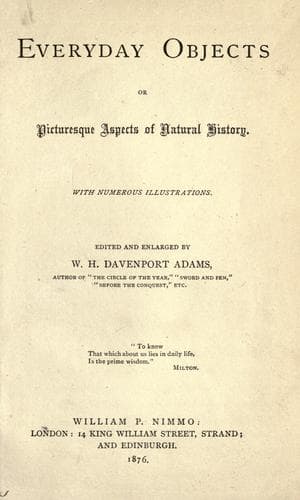
Everyday Objects; Or, Picturesque Aspects of Natural History.Adams, W. H. Davenport (William Henry Davenport)
History
Everyday Objects; Or, Picturesque Aspects of Natural History.
Adams, W. H. Davenport (William Henry Davenport)
Natural history
You do not cease to proclaim as an axiom that "there are no abrupt
intervals in Nature;" that Nature never ventures upon sudden leaps
or bounds ("in natura non datur saltus"), and yet you would make
an exception for the world of thought--a world which no more lies
outside the laws of nature than does the physical world. The former
ought even to secure our preference; it is there only that we are
free, that we can become true creators, by creating for ourselves
our own happiness; that we can grow great before our own eyes, by
following, not the tyrannous will of the _brute_, but the tender
voice of the _angel_; by listening to conscience--that pure and
infallible counsellor--conscience, the foundation of all justice, the
latent force of generations passing away and coming, the universal
gravitation of our species as of all the ultra-terrestrial humanities.
* * * * *
But how can the humanities, with which we suppose the universe to be
peopled,--how can they communicate with one another?
The law of attraction comprehends not only the celestial bodies,
but also their intervals, the intersidereal spaces. Do these spaces
present a void to the thinking beings who probably people the stars?
Everything, force and matter, testifies to an entire unity of plan
or thought, and the mind which is powerful enough to rise above all
the attractions and influences of the body, the mind which, by its
continuous labour, alone renders life and man of any importance, the
mind once detached from the animal nature which it drags behind it
like a prisoner to the chariot of his conqueror, shall it be inferior
to inert matter? shall it be less than a ship without its compass?
Continuous here, shall that continuity be elsewhere broken up? Surely
this is impossible.
* * * * *
But how are we to recognise this continuity of essence in a spirit
which, like man's, appears unavoidably fixed, like a parasite, to the
surface of a planet?
Here lies the whole difficulty of the question; a question all the
more perplexing because, in the search after scientific truth,
the mind walks surely and steadily, except when resting upon the
senses,--which are the backbone, so to speak, of the experimental
method.
Answers, indeed, are not wanting, for each religion has its own.
Every creed attempts to solve the problem. But then, faith is
required to accept the answer or solution, and alas! faith is not
implanted in every soul. It is useless, therefore, to wish that it
might be the gift of those who, to the authority of tradition and
long-established dogmas, prefer the liberty of discussion and the
axioms of science. Are our bigots actually aware of what they do when
they seek to compel into their circle of belief those minds which
tend to escape from it at a tangent? We assert that in so doing they
are guilty of an act of iniquity, of a veritable blasphemy.
* * * * *
Public-domain text, read in full here on John Shaqi.
Reviews
Reviews
No reviews yet
Be the first to share your thoughts on this work.
Elsewhere in the archive
Join the Discussion
Join the discussion
Sign in to leave a comment or review.
Sign InorCreate an account