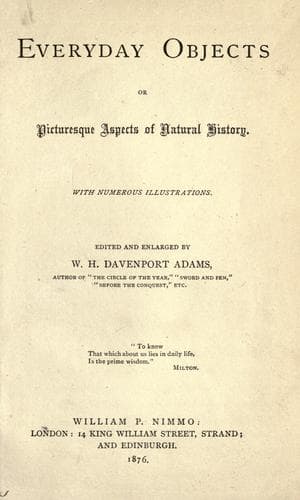
Everyday Objects; Or, Picturesque Aspects of Natural History.Adams, W. H. Davenport (William Henry Davenport)
History
Everyday Objects; Or, Picturesque Aspects of Natural History.
Adams, W. H. Davenport (William Henry Davenport)
Natural history
"Child of the sun! pursue thy rapturous flight,
Mingling with her thou lov'st in fields of light;
And, where the fields of Paradise unfold,
Quaff fragrant nectars from their cups of gold.
There shall thy wings, rich as an evening sky,
Expand and shut with silent ecstasy!
Yet wert thou once a worm, a thing that crept
On the bare earth, then wrought a tomb and slept.
And such is man; soon from his cell of clay
To burst a seraph in the blaze of day."[92]
To assure ourselves by observation that, in living matter, there
are organs irrevocably destined to decay or disappear, while others
incline and grow towards perfection, is certainly one of the noblest
studies imaginable. If philosophers, instead of employing their time
in profitless speculations, devoted themselves to the examination of
the great Book of Nature, God's second revelation, they would long
ago have discovered what they are still seeking.
And we should now know how to distinguish, in man as in the insect,
the rudimentary condition of his future life; and the belief in the
immortality of the soul would not only be the creed of the Christian,
but a scientific truth.
FOOTNOTES:
[Footnote 78: Reference is here invited to Humboldt's _thermal_ and
_isothermal_ lines. See Dr A. K. Johnston's "Physical Atlas," and
Humboldt's "Kosmos."]
[Footnote 79: Sir J. Herschel, "Preliminary Discourse on the Study of
Natural Philosophy."]
[Footnote 80: Professor Balfour's "Manual of Botany," pp. 566-568.]
[Footnote 81: Pliny, "Hist. Nat.," xxii. 46.]
[Footnote 82: Martial, "Epigram.," i. 21.]
[Footnote 83: "Annales des Sciences Naturelles," i. 18.]
[Footnote 84: Count de Castelnau, "Histoire Naturelle des
Coléoptères," i. 7.]
[Footnote 85: As recorded, in a condensed form, in _The Academy_
(Feb. 12, 1870), pp. 131, 132.]
[Footnote 86: This section is translated from M. Hoefer, without
addition or alteration.]
[Footnote 87: From these slow movements, which have been designated
the "secular inequalities," we might with some probability infer
the end of the world, which even Newton regarded as certain,--at
least, unless "the Great Architect at times retouched His work."
The inequalities or secular variations affect the elements of the
orbits, such as the inclination of the plane of the orbit,--the
semi-major axis of the ellipse, or the mean distance of the planet
from the sun,--the eccentricity of the ellipse, or the relation
between the distance which separates the forces from the centre
and the semi-major axis assumed to be unity,--and the movements of
the perihelions and the nodes. These elements change with extreme
slowness. Thus, the inclination of Jupiter diminishes by 8" in a
century; and that of Saturn increases by 9"; but the very ecliptic
varies,--it diminishes 33" in a century.
The variations of the eccentricities are scarcely computable by
centuries; their effect is, that the ellipses insensibly approach or
recede from a circular form.
Public-domain text, read in full here on John Shaqi.
Reviews
Reviews
No reviews yet
Be the first to share your thoughts on this work.
Elsewhere in the archive
Join the Discussion
Join the discussion
Sign in to leave a comment or review.
Sign InorCreate an account