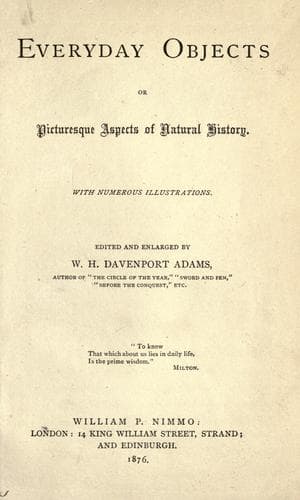
Everyday Objects; Or, Picturesque Aspects of Natural History.Adams, W. H. Davenport (William Henry Davenport)
History
Everyday Objects; Or, Picturesque Aspects of Natural History.
Adams, W. H. Davenport (William Henry Davenport)
Natural history
[Footnote 89: The equatorial diameter of Saturn in English miles is
79,147; its density, ·12, the Earth = 1; its distance from the sun,
906,200,000 miles; and the inclination of its orbit to the ecliptic,
2° 29' 36".]
[Footnote 90: Our author, it must be understood, is considering these
questions apart from the Scriptural standpoint.]
[Footnote 91: William Drummond.]
[Footnote 92: Samuel Rogers.]
APPENDIX.
APPENDIX.
THE SOLAR ECLIPSE OF 1870.
The total Solar Eclipse, which is to render famous the month of
December in the present year--famous, that is, in astronomical
annals--deserves, we think, some special notice in our pages. In
1860, the _Himalaya_ was fitted out by Government for the use of
the _savants_ desirous of observing the Solar Eclipse visible that
year in Spain, and the results of the expedition were so important
as fully to warrant the liberality of the Government. The eclipse of
the present year will also be visible in Spain, but the path of the
sun's shadow will pass as far north as Cape Spartel, and, crossing
Algeria, will go northwards, _via_ Sicily, and in the direction of
Constantinople. The totality of the eclipse will not last so long
as that of the Indian eclipse in 1868. The sun will be hidden from
sight for no longer period than about two minutes twelve seconds, and
whatever observations our astronomers are anxious to make must be
made in that brief interval. It may not unreasonably be suggested
that, in so short a time, no data can be ascertained worth the
cost and trouble the proposed expedition will necessitate; but the
reader requires to be informed that the most valuable acquisitions
lately won in the region of solar physics have been the result of
observations which may almost be described as momentary.
What, then, is the important point on which our astronomers hope to
gain information from a close examination of the approaching eclipse?
This question has been ably answered by a well-informed writer in
the _Daily News_. The great problem to be solved is that of the
strange appearance of the solar corona; of that glory of light which
rings round the great luminary when totally eclipsed, to it, as some
astronomers assert, a purely optical phenomenon, or, as others more
reasonably declare, "one of the most imposing of all the features
of the solar system." It is true that the former opinion is held by
such men as Faye, Lockyer, and Professor Airy; but if it be founded
on fact, the phenomenon loses all its importance, and nearly all
its interest. If the other opinion prove correct, and the corona is
discovered to be in reality an appendage of the orb of day, then
the mind must at once acknowledge its unsurpassed splendour, its
magnificent proportions. As its glow and ethereal radiancy often
extends several degrees from the eclipsed sun, its diameter cannot be
less than 2,800,000 miles.
Public-domain text, read in full here on John Shaqi.
Reviews
Reviews
No reviews yet
Be the first to share your thoughts on this work.
Elsewhere in the archive
Join the Discussion
Join the discussion
Sign in to leave a comment or review.
Sign InorCreate an account