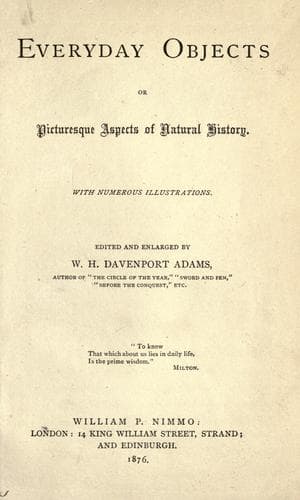
Everyday Objects; Or, Picturesque Aspects of Natural History.Adams, W. H. Davenport (William Henry Davenport)
History
Everyday Objects; Or, Picturesque Aspects of Natural History.
Adams, W. H. Davenport (William Henry Davenport)
Natural history
This argument, however, may fail on the ground of its very
simplicity. Mr Proctor, therefore, proceeded to inquire whether air
which lies between the observer and the corona is really illuminated.
He pointed out that all round the sun, for many degrees, perfect
darkness should prevail if the illumination of the atmosphere by
direct solar light were in question. As to the atmospheric glare
caused by the coloured flames and prominences of the sun's disc, it
must be comparatively small, bearing no higher proportion to the
actual light of the atmosphere than ordinary atmospheric glare bears
to actual sunlight,--a very small proportion indeed.
But a fatal objection to the theory that the corona is due either
to the glare from the prominences or to light reflected from the
surrounding air, consisted in the fact that the so-called glare ought
to cover the moon's disc.
Mr Proctor next referred to a number of observations in support
of the view that the coronal light is not terrestrial; such as
the appearance of glare during partial eclipses, the glare always
trenching on the lunar disc; the relatively greater darkness of the
central part of the lunar disc in annular eclipses; the visibility
of that part of the lunar disc which lies beyond the sun in partial
eclipses, the limb being seen dark on the background of the sky; and
the visibility of the corona in partial eclipses;--were its most
distinctive peculiarities, having been recognised when the sun's face
is not wholly covered.
What, then, _is_ the actual nature of the corona?
May it not consist of the denser parts of meteoric systems travelling
round the sun?
Leverrier has shown, and Mr Buxendell has helped to show, that the
motion of Mercury's perihelion indicates the presence of a ring
of bodies in the vicinity of the sun; but we have good reason for
believing that for each meteor system our earth encounters, there
must be millions on millions whose perihelia lie within the earth's
orbit. Since the earth meets with fifty-six such systems, it will be
seen how enormous probably is the total number.
Is, then, the corona simply the projection of these systems,
illuminated as they must be by an intensity of solar light exceeding
many hundred-fold that which illumines our summer days, nay, in
certain places, were raised by his heat to a state of incandescence?
* * * * *
Such are some of the questions which, it is hoped, the eclipse of
December 1870 will help to solve; and we think our readers will
admit that their importance justifies us in looking forward to the
approaching phenomenon with anxious curiosity. The bounds of human
knowledge are gradually enlarging; and as they enlarge, they do but
more vividly illustrate the infinite wisdom and perfectness of the
scheme of creation.
COLOURED STARS.
Public-domain text, read in full here on John Shaqi.
Reviews
Reviews
No reviews yet
Be the first to share your thoughts on this work.
Elsewhere in the archive
Join the Discussion
Join the discussion
Sign in to leave a comment or review.
Sign InorCreate an account