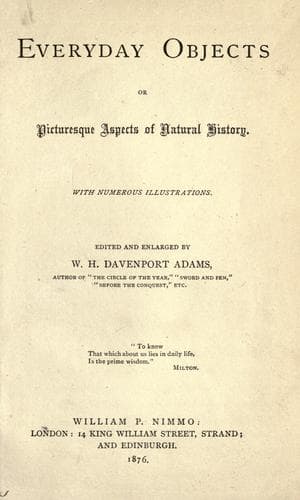
Everyday Objects; Or, Picturesque Aspects of Natural History.Adams, W. H. Davenport (William Henry Davenport)
History
Everyday Objects; Or, Picturesque Aspects of Natural History.
Adams, W. H. Davenport (William Henry Davenport)
Natural history
Our poets may chant the praises of our modest, simple nights, of our
calm, hushed heavens, bright only with the beauty of the silver moon,
which pours its pale lustre with a winning charm on town and tree, on
wood and lake. They may sing, as Barry Cornwall sings--
"Now to thy silent presence, night!
Is this my first song offer'd: oh! to thee
That lookest with thy thousand eyes of light--
To thee and thy starry nobility
That float with a delicious murmuring--
Though unheard here--about thy forehead blue;
And as they ride along in order due,
Circling the round globe in their wandering.
To thee their ancient queen and mother sing....
Not dull and cold and dark art thou:
Who that beholds thy clearer brow,
Endiademed with gentlest streaks
Of fleecy-silver'd cloud, adorning
Thee, fair as when the young sun wakes....
But must feel thy powers."
In some such ecstatic strains as this we may laud our moonlit nights,
acknowledging in our heart of hearts the power of their silent,
subtle loveliness; but how shall we compare them with nights made
wonderful by a blending of golden and emerald fires? by the shifting
coruscations of stars of many colours?
But here we must conclude a dissertation which threatens to become a
rhapsody. It is difficult, however, to treat of such a theme, and to
follow up all its strange and startling suggestions, in sober prose.
THE ALPINE FLORA.
The Alpine Flora, of which in a preceding section we have given a
very imperfect sketch, has been examined with loving minuteness by
Messrs Elijah Walton and T. G. Bonney; and other united results of
pen and pencil have been placed before the public in a handsome
volume entitled "Flowers from the Upper Alps, with Glimpses of
their Homes." A somewhat similar subject has been treated with much
delicacy of feeling and fervour of description by the Rev. Hugh
Macmillan, in his "Holidays in High Lands."
Among the Alpine plants sketched and described by Messrs Walton
and Bonney are the beautiful _Lychnis_, a close relative of our
corn-cockle and garden pink, and so called, says Gerard, the quaint
old botanist, because it is a "light-giving flower." He also met with
immense breadths of violet _pansies_,--"that's for thoughts," says
Ophelia,--covering the sloping pasture-grounds of the Col d'Autune,
and blending with rose and star gentians, soldanellas, primulas, and
anemones. The pink blossoms and bare stem of the _house leek_ is
found "among the blocks tumbled down from the ice-streams, and its
sparkling clusters seem to glow with a richer hue on the stony ruin
which has shattered the pine, and crushed the life even out of the
rhododendron."
Public-domain text, read in full here on John Shaqi.
Reviews
Reviews
No reviews yet
Be the first to share your thoughts on this work.
Elsewhere in the archive
Join the Discussion
Join the discussion
Sign in to leave a comment or review.
Sign InorCreate an account