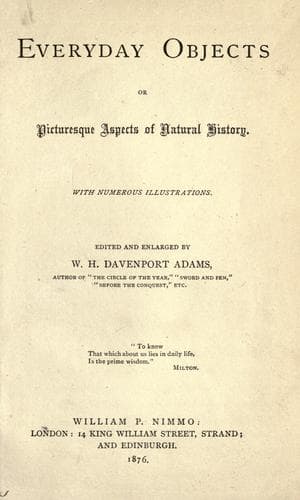
Everyday Objects; Or, Picturesque Aspects of Natural History.Adams, W. H. Davenport (William Henry Davenport)
History
Everyday Objects; Or, Picturesque Aspects of Natural History.
Adams, W. H. Davenport (William Henry Davenport)
Natural history
Earth, the, shape of, as conceived by Homer and Hesiod, 103, 104;
by Seneca, 104;
by the Chaldeans, Anaximander, Anaximenes, and Zenophanes, 105;
by Plato, 105, 106;
by Eudoxes and Aristotle, 106;
by the Greeks and Hebrews, 107;
a problem, 398, 399.
Earwig, the, form of, described, 278-280.
Edelwein, the, in the Alps, description of, 418.
Flammarion, M., on coloured stars, 414, 415.
_Flos Adonis_, the, legend connected with, 169.
Forficulæ, the, group of, characteristics of, 286.
Forget-me-not, the, celebrated by Campbell the poet, 236, 237;
described by Miss Pratt, 238;
analysis of its form, 238, 239;
legends connected with, 239, 240.
Friendship, the test of, 141.
Frigid zones, the, position of, 45, 46;
the lizards of, described, 70, 71.
Galileo, his discoveries in gravitation, 110, 111.
Ganges, the banks of, described, 248.
Garidel, the botanist, on the medical properties of the daisy, 147.
Garden-lily, the, described, 248.
Garden-nightshade, the, its extreme fertility, 82;
description of, 83;
by Tournefort, 84, 85, 89;
its various forms, 85;
its medical properties, 85-87.
Genesis, the book of, quoted, 191.
_Gentiana lutea_, the, its medical properties, 254.
_Gentiana campestris_, described, 256, 257.
Gentianaceæ, the family of, its characteristics described, 252-255;
a Lilliputian specimen of, 255.
Gentians, the, of the Alps, description of, 10.
Gerard, the botanist, quoted, 418.
Gesner, Conrad, the botanist, on the tulip, 154.
Goethe, J. Wolfgang, the poet, quoted, 191.
Gold-crowned wren, the, description of, 64;
its partiality to the society of other birds, 64, 65;
its gymnastic accomplishments, 65;
its cosmopolitan character, 65, 66;
its smallness of size, 66.
Graetz's balls, origin of, stated, 55, 56.
Gramineæ, the, general characteristics of, 88-90;
how described by the naturalists of the Middle Ages, 95, 96.
Gramen, the, Pliny the historian on, 94, 95.
Grasshopper, the, described by Leigh Hunt, 274.
Great Bear, the, origin of the story of, 9, 10;
Homer's reference to, 10.
Grew, the botanist, his theory of the rise of sap, 124;
on the calyx of flowers, 211.
Hay, aromatic, an instance of, 258.
Heat, the action of, described, 313-317.
Heavens, the, movement in, 115, 116.
Hebrews, the, their conception of the earth's supports in space, 107.
Hedgerows, the, wild climbing plants of, 382, 383.
Hepatica, the, described, 168, 169.
Herbs, the food of the primitive Egyptians, 93, 94.
Hipparchus, the astronomer, his discovery of the precession of
the equinoxes, 116;
his astronomical researches, 291, 292.
Public-domain text, read in full here on John Shaqi.
Reviews
Reviews
No reviews yet
Be the first to share your thoughts on this work.
Elsewhere in the archive
Join the Discussion
Join the discussion
Sign in to leave a comment or review.
Sign InorCreate an account