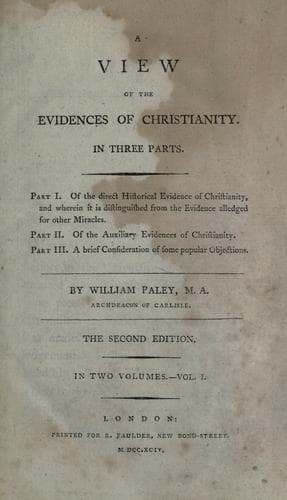
I. Tatian, a follower of Justin Martyr, and who flourished about the
year 170, composed a harmony, or collation of the Gospels, which he
called Diatessaron, of the four. The title, as well as the work, is
remarkable; because it shows that then, as now, there were four, and
only four, Gospels in general use with Christians. And this was little
more than a hundred years after the publication of some of them.
(Lardner, Cred. vol. i. p. 307.)
II. Pantaenus, of the Alexandrian school, a man of great reputation and
learning, who came twenty years after Tatian, wrote many commentaries
upon the Holy Scriptures, which, as Jerome testifies, were extant in his
time. (Lardner, Cred. vol. i. p. 455.)
III. Clement of Alexandria wrote short explications of many books of the
Old and New Testament. (Lardner, Cred. vol. ii. p. 462.)
IV. Tertullian appeals from the authority of a later version, then in
use, to the authentic Greek. (Lardner, Cred. vol. ii. p. 638.)
V. An anonymous author, quoted by Eusebius, and who appears to have
written about the year 212, appeals to the ancient copies of the
Scriptures, in refutation of some corrupt readings alleged by the
followers of Artemon. (Lardner, Cred. vol. iii. p. 46.)
VI. The same Eusebius, mentioning by name several writers of the church
who lived at this time, and concerning whom he says, "There still remain
divers monuments of the laudable industry of those ancient and
ecclesiastical men," (i. e. of Christian writers who were considered as
ancient in the year 300,) adds, "There are, besides, treatises of many
others, whose names we have not been able to learn, orthodox and
ecclesiastical men, as the interpretations of the Divine Scriptures
given by each of them show." (Lardner, Cred. vol. ii. p. 551.)
VII. The last five testimonies may be referred to the year 200;
immediately after which, a period of thirty years gives us Julius
Africanus, who wrote an epistle upon the apparent difference in the
genealogies in Matthew and Luke, which he endeavours to reconcile by the
distinction of natural and legal descent, and conducts his hypothesis
with great industry through the whole series of generations. (Lardner,
Cred. vol. iii. p. 170.)
Ammonius, a learned Alexandrian, who composed, as Tatian had done, a
harmony of the four Gospels, which proves, as Tatian's work did, that
there were four Gospels, and no more, at this time in use in the church.
It affords also on instance of the zeal of Christians for those
writings, and of their solicitude about them. (Lardner, Cred. vol. iii.
p. 122.)
And, above both these, Origen, who wrote commentaries, or homilies, upon
most of the books included in the New Testament, and upon no other books
but these. In particular, he wrote upon Saint John's Gospel, very
largely upon Saint Matthew's, and commentaries, or homilies, upon the
Acts of the Apostles. (Lardner, Cred. vol. iii. pp. 352, 192, 202 & 245.)
Public-domain text, read in full here on John Shaqi.
Reviews
Reviews
No reviews yet
Be the first to share your thoughts on this work.
Elsewhere in the archive
Join the Discussion
Join the discussion
Sign in to leave a comment or review.
Sign InorCreate an account