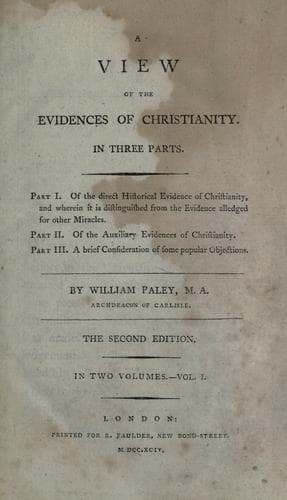
* Great and inestimably beneficial effects may accrue from the mission
of Christ, and especially from his death, which do not belong to
Christianity as a revelation: that is, they might have existed, and they
might have been accomplished, though we had never, in this life, been
made acquainted with them. These effects may be very extensive; they may
be interesting even to other orders of intelligent beings. I think it is
a general opinion, and one to which I have long come, that the
beneficial effects of Christ's death extend to the whole human species.
It was the redemption of the world. "He is the propitiation for our
sins, and not for ours only, but for the whole world;" 1 John ii. 2.
Probably the future happiness, perhaps the future existence of the
species, and more gracious terms of acceptance extended to all, might
depend upon it or be procured by it. Now these effects, whatever they
be, do not belong to Christianity as a revelation; because they exist
with respect to those to whom it is not revealed.
_________
Secondly; morality, neither in the Gospel nor in any other book, can be
a subject of discovery, properly so called. By which proposition I mean
that there cannot, in morality, be anything similar to what are called
discoveries in natural philosophy, in the arts of life, and in some
sciences; as the system of the universe, the circulation of the blood,
the polarity of the magnet, the laws of gravitation, alphabetical
writing, decimal arithmetic, and some other things of the same sort;
facts, or proofs, or contrivances, before totally unknown and unthought
of. Whoever, therefore, expects in reading the New Testament to be
struck with discoveries in morals in the manner in which his mind was
affected when he first came to the knowledge of the discoveries above
mentioned: or rather in the manner in which the world was affected by
them, when they were first published; expects what, as I apprehend, the
nature of the subject renders it impossible that he should meet with.
And the foundation of my opinion is this, that the qualities of actions
depend entirely upon their effects, which effects must all along have
been the subject of human experience.
When it is once settled, no matter upon what principle, that to do good
is virtue, the rest is calculation. But since the calculation cannot be
instituted concerning each particular action, we establish intermediate
rules; by which proceeding, the business of morality is much
facilitated, for then it is concerning our rules alone that we need
inquire, whether in their tendency they be beneficial; concerning our
actions, we have only to ask whether they be agreeable to the rules. We
refer actions to rules, and rules to public happiness. Now, in the
formation of these rules, there is no place for discovery, properly so
called, but there is ample room for the exercise of wisdom, judgment,
and prudence.
Public-domain text, read in full here on John Shaqi.
Reviews
Reviews
No reviews yet
Be the first to share your thoughts on this work.
Elsewhere in the archive
Join the Discussion
Join the discussion
Sign in to leave a comment or review.
Sign InorCreate an account