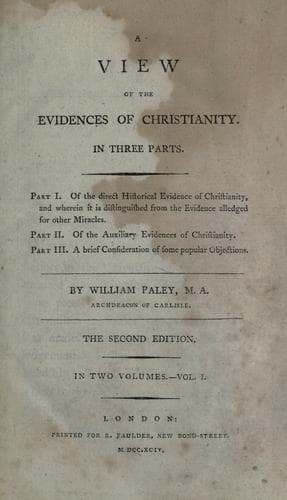
The history of the resurrection of Christ is a part of the evidence of
Christianity: but I do not know whether the proper strength of this
passage of the Christian history, or wherein its peculiar value, as a
head of evidence, consists, be generally understood. It is not that, as
a miracle, the resurrection ought to be accounted a more decisive
proof of supernatural agency than other miracles are; it is not that, as
it stands in the Gospels, it is better attested than some others; it is
not, for either of these reasons, that more weight belongs to it than to
other miracles, but for the following, viz., That it is completely
certain that the apostles of Christ, and the first teachers of
Christianity, asserted the fact. And this would have been certain, if
the four Gospels had been lost, or never written. Every piece of
Scripture recognizes the resurrection. Every epistle of every apostle,
every author contemporary with the apostles, of the age immediately
succeeding the apostles, every writing from that age to the present
genuine or spurious, on the side of Christianity or against it, concur
in representing the resurrection of Christ as an article of his history,
received without doubt or disagreement by all who called themselves
Christians, as alleged from the beginning by the propagators of the
institution, and alleged as the centre of their testimony. Nothing, I
apprehend, which a man does not himself see or hear can be more certain
to him than this point. I do not mean that nothing can be more certain
than that Christ rose from the dead; but that nothing can be more
certain than that his apostles, and the first teachers of Christianity,
gave out that he did so. In the other parts of the Gospel narrative, a
question may be made, whether the things related of Christ be the very
things which the apostles and first teachers of the religion delivered
concerning him? And this question depends a good deal upon the evidence
we possess of the genuineness, or rather perhaps of the antiquity,
credit, and reception of the books. On the subject of the resurrection,
no such discussion is necessary, because no such doubt can be
entertained. The only points which can enter into our consideration are,
whether the apostles knowingly published a falsehood, or whether they
were themselves deceived; whether either of these suppositions be
possible. The first, I think, is pretty generally given up. The nature
of the undertaking, and of the men; the extreme unlikelihood that such
men should engage in such a measure as a scheme; their personal toils,
and dangers and sufferings in the cause; their appropriation of their
whole time to the object; the warm and seemingly unaffected zeal and
earnestness with which they profess their sincerity exempt
their memory from the suspicion of imposture. The solution more
deserving of notice is that which would resolve the conduct of the
apostles into enthusiasm; which would class the evidence of Christ's
Public-domain text, read in full here on John Shaqi.
Reviews
Reviews
No reviews yet
Be the first to share your thoughts on this work.
Elsewhere in the archive
Join the Discussion
Join the discussion
Sign in to leave a comment or review.
Sign InorCreate an account