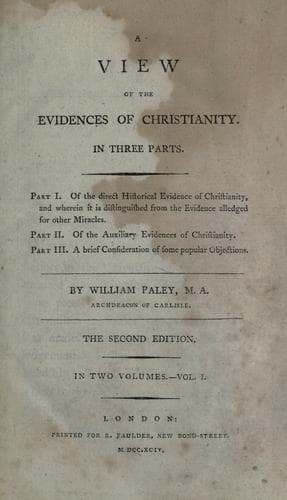
There is, however, another class of writers to whom the answer above
given, viz. the unsuitableness of any such appeals or references as the
objection demands to the subjects of which the writings treated, does
not apply; and that is the class of ancient apologists, whose declared
design it was to defend Christianity, and to give the reasons of their
adherence to it. It is necessary, therefore, to inquire how the matter
of the objection stands in these.
The most ancient apologist of whose works we have the smallest knowledge
is Quadratus. Quadratus lived about seventy years after the ascension,
and presented his apology to the Emperor Adrian. From a passage of this
work, preserved in Eusebius, it appears that the author did directly and
formally appeal to the miracles of Christ, and in terms as express and
confident as we could desire. The passage (which has been once already
stated) is as follows: "The works of our Saviour were always
conspicuous, for they were real: both they that were healed, and they
that were raised from the dead, were seen, not only when they were
healed or raised, but for a long time afterwards; not only whilst he
dwelled on this earth, but also after his departure, and for a good
while after it; insomuch as that some of them have reached to our
times," (Euseb. Hist. I. iv. c. 3.) Nothing can be more rational or
satisfactory than this.
Justin Martyr, the next of the Christian apologists, whose work is not
lost, and who followed Quadratus at the distance of about thirty years,
has touched upon passages of Christ's history in so many places, that a
tolerably complete account of Christ's life might be collected out of
his works. In the following quotation he asserts the performance of
miracles by Christ, in words as strong and positive as the language
possesses: "Christ healed those who from their birth were blind, and
deaf, and lame; causing, by his word, one to leap, another to hear, and
a third to see; and having raised the dead, and caused them to live, he,
by his works, excited attention, and induced the men of that age to know
him: who, however, seeing these things done, said that it was a magical
appearance, and dared to call him a magician, and a deceiver of the
people." (Just. Dial. p. 258, ed. Thirlby.)
Public-domain text, read in full here on John Shaqi.
Reviews
Reviews
No reviews yet
Be the first to share your thoughts on this work.
Elsewhere in the archive
Join the Discussion
Join the discussion
Sign in to leave a comment or review.
Sign InorCreate an account