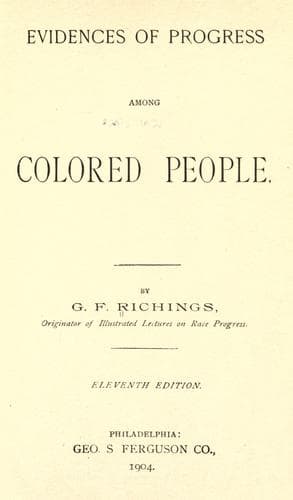
Evidences of Progress Among Colored PeopleRichings, G. F.
History
Evidences of Progress Among Colored People
Richings, G. F.
African Americans
After graduating from the common schools in June, 1869, he entered the
Preparatory Department of Howard University, Washington, D. C., and
finished the course, entering college in September, 1871. He stood at
the head of his class throughout the course, making special record in
the foreign languages, in belles lettres, and as a public speaker. In
the summer of 1871, he lectured at various places in Virginia. Although
a very young man, being then only seventeen years of age, he was heard
by large audiences and took back to Howard University enough money to
get well started in his college course. In the midst of his junior
year, feeling that the facilities for the study of the sciences were
better in the University of South Carolina than at Howard University,
Mr. Stewart left the latter and entered the former institution, and
in December, 1875, he graduated, at the head of his class, from the
College and Law Departments of the University of South Carolina,
delivering the valedictory oration, and receiving the degrees of
Bachelor of Arts and Bachelor of Laws.
[Illustration: T. McCANTS STEWART, ESQ.]
Gen. Robert B. Elliott, one of the ablest men of his day, and, at that
time, one of the most successful practitioners at the South Carolina
bar, took Mr. Stewart into partnership and formed the law firm of
Elliott, Dunbar & Stewart, which firm was retained in many important
cases. Mr. Stewart began his professional career in a murder case, in
which there was unusual interest in every part of the State. The ablest
attorneys and counsel appeared for the people and Gen. Elliott and Mr.
Stewart appeared for the defence. The General guided his young partner,
but imposed upon him the burden of the work.
Mr. Dunbar died early in 1876, and Hon. D. Augustus Straker, now
Circuit Court Commissioner, Detroit, Michigan, entered the law firm
which then became Elliott, Stewart & Straker. The firm practised in
several counties of the State. Wherever he appeared, Mr. Stewart's
management of his cases was highly skilful, and he was usually
successful. The Clarendon _Press_, a newspaper edited and published
by Southern white men at Manning, S. C., makes this reference to
Mr. Stewart's appearance in court there: "We must admit that Mr.
Stewart displayed signal ability in the management of several cases.
His respectful manner and modesty have created for him a favorable
impression amongst the people."
Public-domain text, read in full here on John Shaqi.
Reviews
Reviews
No reviews yet
Be the first to share your thoughts on this work.
Elsewhere in the archive
Join the Discussion
Join the discussion
Sign in to leave a comment or review.
Sign InorCreate an account