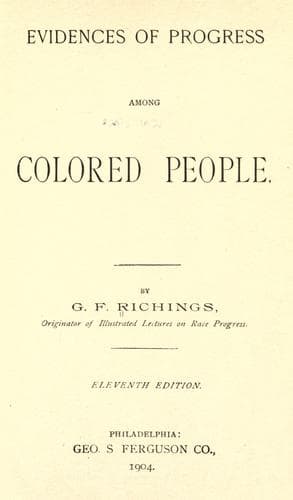
Evidences of Progress Among Colored PeopleRichings, G. F.
History
Evidences of Progress Among Colored People
Richings, G. F.
African Americans
William H. Davis, who has a well-equipped shoe store in Louisville,
Ky., deserves special mention in our publication. Mr. Davis is a young
man of about 26 years of age and owes his success entirely to his own
efforts. He was at one time engaged as private secretary by the mayor
of that city. He afterwards taught type-writing and short-hand in the
schools there. It might be well to mention that he taught himself
both type-writing and short-hand, as none of the schools there where
those branches were taught would admit colored students. There are
but very few colored men engaged in the shoe business, and I know of
none who have as large a stock and are in every way as well prepared
to suit all kinds of trade as Mr. Davis. He has in connection with his
stock of boots and shoes a fine line of furnishing goods, also employs
a first-class workman, so that he can take orders for fine hand-made
shoes for men and women. I hope that this short sketch and picture
of Mr. Davis may inspire other young men to start in some business
enterprise. The sooner colored men begin to represent some of the
business interests of this country the better for the race. There is
not a city in the country where the colored population is large that
several business enterprises could not be started by colored men with
success. Every store owned and controlled by a colored man with success
not only helps him, but it in a way lifts up the entire race, and shows
that colored men can do other things besides clean houses and drive
coal-carts. Mr. Davis finds to his surprise that he has a fair trade
among the white people; that fact alone should encourage other young
men to make an effort to go into some business. As long as colored men
own no stores, they have no right to complain of their treatment in
stores owned by white people. When colored men are felt as competitors
in business, then, and not until then, will white men see the need of
making any special effort to secure and hold colored people's trade.
Then, too, when members of the race own large stores, they can give
employment to young women as clerks, and by so doing take a large
number of colored girls out of wash-tubs and cook kitchens. Mr. Davis
says that he has not had the support he had hoped for from the better
class of colored people, such as the teachers and other professional
people. But he feels that that will come in time. In closing this
sketch I regret to say that Louisville has for a city with such a large
colored population a very small number of colored men engaged in any
kind of business. In fact, the whole State of Kentucky is behind in
that respect. I have found but very few towns in the State that had
colored men doing any kind of business. Mr. Davis desires that any
young men who want to go into business, and feel that they would like
some advice and information as how to start, should write to him, and
he will gladly help them in the way of giving them an account of how
Public-domain text, read in full here on John Shaqi.
Reviews
Reviews
No reviews yet
Be the first to share your thoughts on this work.
Elsewhere in the archive
Join the Discussion
Join the discussion
Sign in to leave a comment or review.
Sign InorCreate an account