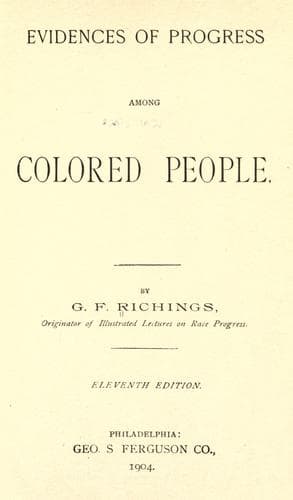
Evidences of Progress Among Colored PeopleRichings, G. F.
History
Evidences of Progress Among Colored People
Richings, G. F.
African Americans
Dr. W. T. Dinwiddie, a young man who is engaged in the practice of
dentistry at Lexington, Ky., is a credit to the race. He is a native
of Danville, Ky., where he attended the public schools of that city,
afterwards taking a two years' course in the Knoxville College at
Knoxville, Tenn. Dr. Dinwiddie first learned the carpenter's trade,
and was regarded as a very fine workman; but, having a natural desire
to practice dentistry, he decided to enter Meharry Medical and Dental
College at Nashville, Tenn., and fit himself for the practice of
that profession. After a three years' course he graduated with high
honors, and was called by the President and Faculty of Meharry Dental
College to accept a professorship; and he took the chair of Prosthetic
Dentistry, which position he held with both success and honor, until
he resigned to enter into the practice of his profession at Lexington,
Ky., where he has by his most excellent workmanship and genial manners
built up a very large practice.
JAMES E. DIXON.
[Illustration: J. E. DIXON.]
Mr. James E. Dixon, of Providence, R. I., belongs to that class of
men who are helpful to my book in enabling me to demonstrate that the
colored people are entering all the professions and business walks of
life in which white men enter and succeed.
Mr. Dixon went to the North from Richmond, Va. Having lost both his
parents at a very early age, it left him to look after himself, just
at the time when a loving mother is most needed. What he has in the
way of an education was obtained at New Bedford, Mass. But having a
desire to travel, he accepted an offer to go to sea, which vocation
he followed for a number of years, rounding the globe at least seven
times, visiting one or more parts of every continent, inclusive of
Australia, New Zealand and a number of Islands in both the Pacific
and Atlantic Oceans. Finding it to his advantage, he hailed from an
English port, and stuck to the English Merchant Service. He secured
a mate's certificate, and worked himself up to a position as chief
officer of one of the finest sailing ships under the English flag. But
by an unfortunate accident in Calcutta, July 4, 1884, he lost his right
arm. He then returned to New Bedford, Mass., and after a hard struggle
against big odds, mastered telegraphy. The Western Union Telegraph Co.,
in recognition of his services in their main office, appointed him on
June 11, 1889, as manager of their branch office at the Parker House,
New Bedford, which place he held until he resigned June 3, 1893, to
take charge of his present position at Signal Tower on the main line of
the New York, New Haven and Hartford Rail Road, at Providence, R. I.
Some idea of his work and responsibilities is given in this statement.
In 1894, 34,284 trains passed this point, and the number is never under
this. The operator has to know and report the exact condition of every
train. In addition he has to give a signal to each train whether or not
it is all right to go ahead.
Public-domain text, read in full here on John Shaqi.
Reviews
Reviews
No reviews yet
Be the first to share your thoughts on this work.
Elsewhere in the archive
Join the Discussion
Join the discussion
Sign in to leave a comment or review.
Sign InorCreate an account