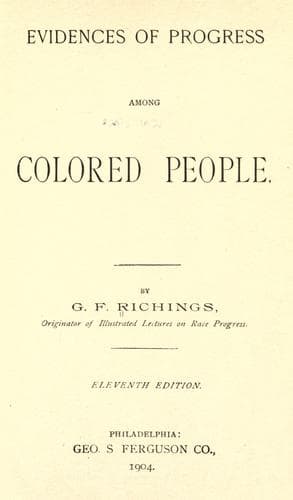
Evidences of Progress Among Colored PeopleRichings, G. F.
History
Evidences of Progress Among Colored People
Richings, G. F.
African Americans
The Washington Commission and Supply Company of Washington, D. C.,
started in 1897, is a movement on the part of a number of Colored men
of this city to control much of the trade among the Colored residents
and to give the youth an opportunity in business pursuits. It is a
co-operative concern, but somewhat restrictive as to membership. Those
who started the enterprise decided, in order to insure success, it
should be self-supporting. Thirty men of families, fifteen of whom were
clergymen and fifteen laymen, joined heartily in the enterprise. It
was estimated that these families would spend from $20 to $40 each for
table supplies. If these men would patronize their own interests, the
store would do a business from $600 to $1000 per month independent of
outside trade.
The store has been in operation but three months. Three clerks are
employed and five agents are at work. The store has sold a little
over $1800.00 worth of goods in these three months. Indications are
flattering for a larger business.
The last week before writing this, was the best in its history. It
contemplates opening branch stores all over the city. The authorities
believe in moving continuously. They believe it is only a matter of
time when through the pastors connected with them and through their
many friends they will control much of the trade of the 85,000 colored
people in the District of Columbia. They will add a boot and shoe
business.
CHAPTER XXII.
PATENTS AND OTHER BUSINESS INTERESTS.
Among the colored people we find a few inventors whose patents are
being used throughout this country. Mr. E. McCoy, of Detroit, Mich.
invented the "Lubricator," and it is being used on nearly all the
railroad engines in the United States. A large factory has been built
in Detroit for the manufacture of the Lubricator. The late Mr. D. F.
Black, of Mechanicsburg, Pa., had invented several patents, and was
before his death engaged in manufacturing a cocoanut food, and, I
understand, met with fair success. Rev. J. B. Randolph, of Trenton, N.
J., has taken out a patent on an apparatus for heating and cooking,
claiming that at least one-half of the fuel now used in heating a house
can be saved by the use of his patent.
Mr. H. Creamer, of Brooklyn, N. Y., has invented an automatic steam
pump that seems to have made a good impression among those who have
tested it, for it is very highly spoken of.
I shall mention in this chapter a few colored men I have met who are
engaged in various lines of business. Mr. W. A. Hazel, of St. Paul,
Minn., is a decorator and designer. Some of the handsomest window glass
used for churches is designed by Mr. Hazel.
Mr. Jas. H. Matthews, of New York City, has built up a very large
business as an undertaker. His patrons are among all classes of people.
He has been an active member of the Undertakers' Association of the
State. In fact, he has held responsible positions in the association.
Public-domain text, read in full here on John Shaqi.
Reviews
Reviews
No reviews yet
Be the first to share your thoughts on this work.
Elsewhere in the archive
Join the Discussion
Join the discussion
Sign in to leave a comment or review.
Sign InorCreate an account