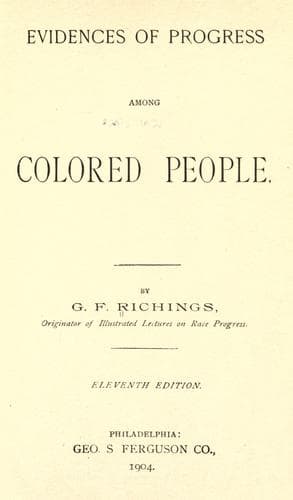
Evidences of Progress Among Colored PeopleRichings, G. F.
History
Evidences of Progress Among Colored People
Richings, G. F.
African Americans
In the fall a lot was purchased on the corner of Eighth and Lendon
streets, and a building 20 × 40 feet was erected thereon. The following
summer a great addition was made to this structure, and now the Trade
Union building contains an area of 3,200 square feet of floor space,
and is now the largest store building owned by colored people in the
city of Winston-Salem.
On January 9, 1899, a charter was granted by the Secretary of State,
and the Trade Union became a corporate body, with a capital privilege
of ten thousand ($10,000) dollars; also rights and powers which enable
the Directors to deal in all manner of real and personal property. On
the second anniversary of this company the assets amounted to more
than $3,000.
It is the purpose of the Union to open a savings bank in connection
with their business. Mr. J. S. Hill, a most excellent man, is now
president of the company.
THREE PROMINENT ARTISTS.
While in Boston, Mass., in 1895, I met Mr. Nelson A. Primus, who
painted that wonderful picture (18 × 24 feet), "Christ Before Pilate."
This gentleman is certainly a remarkable artist and his portrait work
is received in Boston alongside of the productions of the very finest
artists of the city.
Mr. M. E. Bannister, of Providence, R. I., painted the picture called
"Under the Oaks," that was awarded the first gold medal at the great
Centennial Exposition at Philadelphia, Pa., in 1876. His painting was
sold for $1,500.
Prof. H. O. Tanner has painted a picture called "The Banjo Lesson,"
that sold for $800.
The colored race has produced a great many exceptionally fine artists,
and it is in the realm of art that the highest possibilities of any
race are indicated.
Prof. Tanner has recently sold to the French Government for the
Luxembourg Gallery a large picture representing "The Raising of
Lazarus." Mr. Tanner is the second American artist who has sold one of
his paintings to the French Art Gallery.
CHAPTER XXIII.
COLORED EDITORS AND JOURNALISTS.
There are published in the United States to-day between 250 and 300
newspapers and periodicals devoted to the interests of the colored
people. The prices of these, compared with the many other articles of
luxury for which they pay so freely, are ridiculously low; and yet no
field of labor for educated men and women of the race is so perplexing
and encumbered with so many difficulties.
But among those who have made a success of journalism are the men and
women mentioned in this chapter.
T. THOMAS FORTUNE.
Public-domain text, read in full here on John Shaqi.
Reviews
Reviews
No reviews yet
Be the first to share your thoughts on this work.
Elsewhere in the archive
Join the Discussion
Join the discussion
Sign in to leave a comment or review.
Sign InorCreate an account