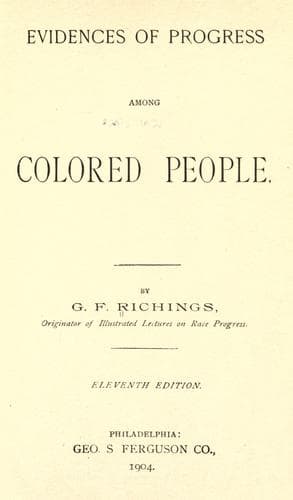
Evidences of Progress Among Colored PeopleRichings, G. F.
History
Evidences of Progress Among Colored People
Richings, G. F.
African Americans
In 1893, Miss Henrietta Vinton Davis organized a colored company in
Chicago, and produced "Dessalines," a play written by William Edgar
Easton, of Texas, a bright young colored man. While the production in
some ways was crude, I am sure that when we take into consideration
how great were the disadvantages under which Miss Davis had to labor,
I feel that the general verdict would be in her favor. Among those who
took part in the play was Miss Fannie Hall, of Chicago, who is without
question a fine dramatic reader, and who should, by all means, be kept
more prominently before the public.
One of the first colored ladies to take up elocution as a profession
was Miss Hallie Quinn Brown, who is well known and admired throughout
the United States. Miss Brown has great powers in winning friends,
and great control over an audience. For several years she spent her
time in England. I had the pleasure of being present at her first
entertainment in London after her arrival. She has had the distinction
of displaying her talent to a greater number of white people than any
other colored lady of her calling.
Mrs. Florida D. Carr, of Savannah, Ga., has made a splendid reputation
as an elocutionist. She is a graduate of the New England Conservatory
of Music and Elocution. I was very much impressed with her power as a
reader. Mrs. Carr has a wonderful voice and perfect control of it in
both humorous and pathetic selections.
In Atlanta, Ga., my attention was called to Mrs. Carrie Steel Logan,
who began a home for orphan children a few years ago; I think in 1889.
She started in a miserable little hut with some five fatherless and
motherless children. At first it was hard to get any help from either
the colored or white people. But right will, as a rule, prevail, and so
it proved in this case, for now I am told that there is not a colored
church in Atlanta that does not give something to support this Home.
The city gave her four acres of ground a short while ago, on which
has been erected a fine brick house. When I visited the Home in 1894
there were fifty-three children being cared for in this institution.
Mrs. Logan visits the merchants of Atlanta from time to time, and by
these visits procures provisions enough to help in the support of these
children.
Mrs. Lucy Thurman, from Jackson, Mich., who has given the best part of
her life to temperance work, is now managing the work among the colored
people. As a public speaker she ranks among the best.
Mrs. Julia Ringwood Coston, who published _Ringwood's Journal_, which
took the place in a way of _The Ladies' Home Journal_, is one of the
remarkable literary women of the race.
Mrs. Harvey Johnson, of Baltimore, has written two very useful books,
which have been published by the American Baptist Publication Society,
one called "Clarence and Corinne," and the other, "The Hazeley Family."
Both were regarded as especially adapted to Sunday-school purposes.
Public-domain text, read in full here on John Shaqi.
Reviews
Reviews
No reviews yet
Be the first to share your thoughts on this work.
Elsewhere in the archive
Join the Discussion
Join the discussion
Sign in to leave a comment or review.
Sign InorCreate an account