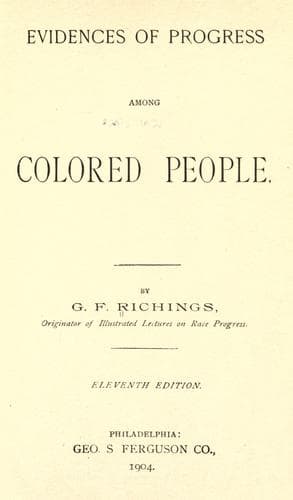
Evidences of Progress Among Colored PeopleRichings, G. F.
History
Evidences of Progress Among Colored People
Richings, G. F.
African Americans
The need of rescue work among our people by our women. The
establishment of Christian homes and asylums for our fallen and wayward.
The separate car law.
Prison reform.
The plantation woman and child.
The John Brown Memorial Association.
The proposed international exposition in Paris, 1900; the part
Afro-American women should take.
The need of a National Afro-American woman's paper.
Plans for raising necessary money and securing necessary support for
the same.
How can the National Federation of Afro-American Women be made to serve
the best interests and needs of our women?
The strength of this new national organization, even while yet in its
infancy, gives encouragement of its ultimate power among the people
it represents. The roll now includes fifty organizations, the average
number composing a local organization being seventy-five members, many
of the clubs having on roll as many as 250 names.
Mrs. Booker T. Washington, wife of that great educator, has a very
interesting history. She is a Southern-born woman, having first seen
the light of day at Macon, Miss., in 1865. She is truly a self-made
woman, the story of her life and struggles to attain intellectual life
being full of pathetic interest. A mere outline is inadequate to do
justice to the heroic efforts that have placed her to-day as one of the
prominent women of her race. One of a large family, of which the mother
was bread-winner, her father having died when she was a small child,
she would have had no opportunity for education had she not through her
own exertions created for herself a way into the school life. Until her
graduation from the Fisk University she gave her own labor in payment
of board and tuition, gaining spending money through services rendered
teachers and pupils--and by teaching at fifteen, it can be readily seen
that all the usual pleasures of youth were sacrificed in the cause
of education. Her experience as a teacher well fitted her to accept
the offer that came to her on graduating, of a place in the faculty
of Tuskegee Institute. She immediately entered upon her duties there,
and at the time of her marriage to the principal of the institution,
she was lady principal. Appreciating her own struggles, she stands, it
is said, as a changeless friend to every girl working her way through
school.
She is one of the leading spirits of this grand organization that
is destined to do wonders for the colored people as a race. She was
succeeded as president by Mrs. Mary C. Terrell, whose portrait is
given and of whom mention is made in connection with school work in
Washington in another part of this book.
MRS. MAMIE E. STEWART.
Public-domain text, read in full here on John Shaqi.
Reviews
Reviews
No reviews yet
Be the first to share your thoughts on this work.
Elsewhere in the archive
Join the Discussion
Join the discussion
Sign in to leave a comment or review.
Sign InorCreate an account