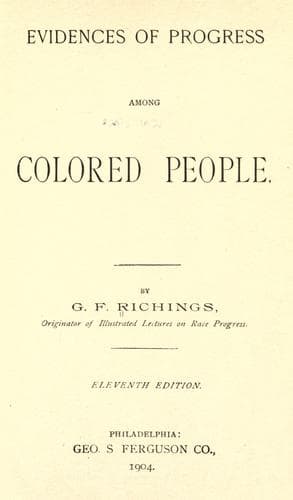
Evidences of Progress Among Colored PeopleRichings, G. F.
History
Evidences of Progress Among Colored People
Richings, G. F.
African Americans
Can the negro race successfully own and operate cotton mills? This
question, so long in doubt, is about to be answered, and we believe in
the affirmative. The first great stride in that direction was taken
when, on the 8th of February, 1898, was laid with Masonic honors the
corner-stone of the handsome three-story brick building, 80 × 120 feet
in dimensions, of the Coleman cotton mill. It was indeed a marked
epoch in the history of the negro race, and pronounced by all present
an entire success. Noted speakers from all over the United States
were invited, and the railroads gave reduced rates from all points.
Following the laying of the corner-stone was the annual election of
old officers, who are as follows: R. B. Fitzgerald, of Durham, N.
C., president; E. A. Johnson, of Raleigh, N. C., vice-president;
and W. C. Coleman, of Concord, N. C., secretary and treasurer. The
following gentlemen constitute the Board of Directors: Rev. S. C.
Thompson, Camden, S. C.; L. P. Berry, Statesville, N. C.; John C.
Dancy, Salisbury, N. C.; Prof. S. B. Pride, Charlotte, N. C.; Prof.
C. F. Meserve, Raleigh, N. C.; and Robert McRee, Concord, N. C. Among
these are some of the highest lights of the negro race, and under
their careful direction we have no doubts as to the final results of
the enterprise. The promoter of this enterprise, W. C. Coleman, is the
wealthiest negro in the State, and he has rallied around him not only
the leaders of his race, but has the endorsement of many of the most
successful financiers among our white citizens throughout the State.
[Illustration: WARREN C. COLEMAN.]
The mill is to have from 7,000 to 10,000 spindles, and from 100 to
250 looms, and, by their charter, will be allowed to spin, weave,
manufacture, finish, and sell warps, yarns, cloth, prints, or other
fabrics made of cotton, wool, or other material. They own at present,
in connection with the plant, about 100 acres of land on the main line
of the Southern Railway, and near the site of the mill. The mill and
machinery with all the fixtures complete will represent an outlay of
nearly $66,000, and will give employment to a number of hands. The
building is now completed and ready for machinery.
Let us add that Concord has reason to and does feel proud of the fact
that she has the only cotton mill in the world owned, conducted, and
operated by the negro race.
At a meeting of the directors recently the capital stock was increased
$50,000, and those wishing a good safe investment should secure some of
this stock. The mill will be under good and safe management, and will,
no doubt, be a paying institution.
Special inducements will be offered to any party or parties who desire
to establish enterprises that colored labor may be employed. Full
particulars can be obtained from the secretary and treasurer, W. C.
Coleman, Concord, N. C.
Public-domain text, read in full here on John Shaqi.
Reviews
Reviews
No reviews yet
Be the first to share your thoughts on this work.
Elsewhere in the archive
Join the Discussion
Join the discussion
Sign in to leave a comment or review.
Sign InorCreate an account