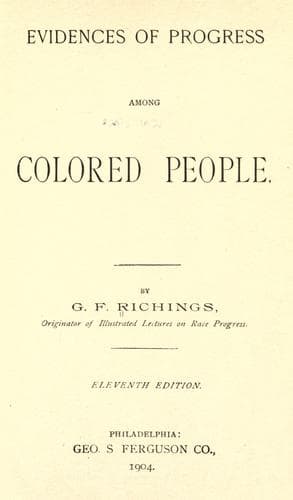
Evidences of Progress Among Colored PeopleRichings, G. F.
History
Evidences of Progress Among Colored People
Richings, G. F.
African Americans
Louis Kastor, of Natchez, Miss., is the only colored man I have found
in my travels engaged in the line of work he represents, at least on
so large a scale as he carries on his business. He is a first-class
harness-maker by trade and owns one of the largest and best-equipped
stores in his line in the country. In addition to the harness he
makes he keeps on hand a large stock of ready-made harness, bridles,
saddles, whips, rugs, in fact, a large and complete stock of all goods
sold by men in his business. Mr. Kastor began first with $65.00, and is
now doing a business of some $22,000 a year. He owns a fine property
for a residence, and has the respect and confidence of the best people
in Natchez. In addition to his own residence Mr. Kastor owns three
other houses, which he has rented. I found him a very intelligent man,
and one who is very anxious to see the colored people advance in every
department of life. He feels that they must be engaged in all lines of
work and business in order that they may succeed.
MISSISSIPPI COTTON MANUFACTURING COMPANY.
This company is located at Jackson, Miss., for the purpose of building
a large cotton mill where colored labor only will be employed.
On nearly every sidewalk, at every railway station from the country
store to the great city, the highways are crowded with idle colored
boys. It is very difficult for them to find employment in the
commercial pursuits of any kind. They would gladly seize an opportunity
to earn a livelihood along the industrial lines if they were permitted.
Hence the necessity of the erection of the cotton factory. The
Mississippi Cotton Manufacturing Company is incorporated under the laws
of the State of Mississippi for the purpose of manufacturing cotton and
woolen goods and such other articles as the directors from time to time
may see fit. Such an enterprise was proposed by the lamented Frederick
Douglass in 1893, who was president of the Freedom Manufacturing
Company, of which Hon. James Hill was vice-president. Owing to the
money panic of '93, Mr. Douglass decided to wait until after the panic
had subsided and business confidence was restored. On the eve of this
restoration of business confidence Mr. Douglass died. The idea has
heretofore prevailed that the negro is not competent to manage or
operate any manufacturing concern or any great business enterprise.
We cannot yield assent to that idea. The young people who are being
educated in the various colleges of this country should not all seek
to go into the professions, and the main object of this company is to
build this factory and give the deserving boys and girls in that State
an opportunity to follow the industrial as well as the professional
walks of life.
The capital stock of the company is $250,000. The shares of stock are
placed at $10 each. Any person, however, can purchase as many shares of
stock as he may desire.
Public-domain text, read in full here on John Shaqi.
Reviews
Reviews
No reviews yet
Be the first to share your thoughts on this work.
Elsewhere in the archive
Join the Discussion
Join the discussion
Sign in to leave a comment or review.
Sign InorCreate an account