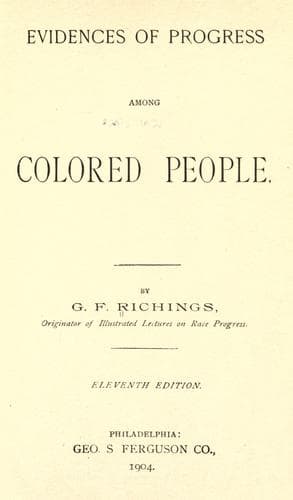
Evidences of Progress Among Colored PeopleRichings, G. F.
History
Evidences of Progress Among Colored People
Richings, G. F.
African Americans
The A. M. E. Zion Church had long desired an institution for a thorough
education of its children, and accordingly a school under the auspices
of the North Carolina Conference was started in 1879 in the town of
Concord, N. C. It was incorporated under the name of Zion Wesley
Institute, and after two sessions, depending upon collections from
the churches of that conference, it was forced to close its doors.
Therefore it was in May, 1881, when it became apparent that the school
must close--then being taught by Prof. A. S. Richardson. The Ecumenical
Conference of the Methodist Church was held this year in England and in
this month of May. Bishop J. W. Hood, D. D., who was president of the
Board of Trustees of the Institute, and Rev. J. C. Price, with other
representatives of the Zion Church, were in attendance.
Bishop Hood, recognizing the ability of Dr. Price, who was then a young
man just out of school, prevailed upon him to become an agent for the
school and to remain in England after the close of the conference.
During the conference Dr. Price made himself famous among the delegates
and visitors as an eloquent orator and after its close had no trouble
in getting before the English people, who welcomed him everywhere
and responded to his appeals in a sum amounting to $9,100. This, of
course, was great encouragement to the Trustees and the Church. The
congregation of the Zion Church, in Concord, offered seven acres of
land for a site to erect buildings and locate the school permanently.
But the trustees decided that Salisbury would be a more favorable place
and the school was located in that city.
It was in the spring of 1882 that Bishops Hood and Lomax, with $3,000
of the money raised by Prof. Price in England and $1,000 donated by
the business men of Salisbury, purchased the site now occupied by
Livingstone College. There was on the place one two-story building with
ten rooms including basement. The tract of land consisted of forty
acres and the total cost of the place amounted to $4,600.
The Board of Bishops at the meeting in Chester, S. C., in September,
1882, adopted Zion Wesley Institute as a connectional school, electing
a faculty with Rev. J. C. Price, president, Rev. C. R. Harris, Prof. E.
Moore, instructors; Mrs. M. E. Harris as matron.
October 9, 1882, the Institute was opened on its own premises in
Salisbury. The name was soon changed to Zion Wesley College, and in
'86 or '87 became Livingstone College, in honor of the great African
explorer, David Livingstone.
It may not be out of place to mention here that the president and
faculty felt that in the scope of the work the institution aimed to
do, it would be less hampered by the new name. The wisdom of this has
doubtless been seen by those intimately associated with the College.
Public-domain text, read in full here on John Shaqi.
Reviews
Reviews
No reviews yet
Be the first to share your thoughts on this work.
Elsewhere in the archive
Join the Discussion
Join the discussion
Sign in to leave a comment or review.
Sign InorCreate an account