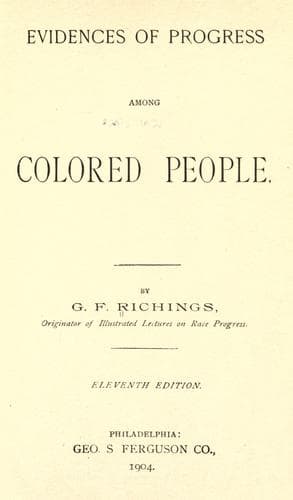
Evidences of Progress Among Colored PeopleRichings, G. F.
History
Evidences of Progress Among Colored People
Richings, G. F.
African Americans
The first day the school opened there were five day students, but no
boarders. About the middle of October the first student from abroad
came--Miss Lizzie Williams, of Newbern, N. C. When the session closed,
however, there were in all ninety-three students. A small frame
building (16 × 40) for boys had been erected and the girls were crowded
in rooms with two beds each, and so great was the need for rooms that
they were compelled in some instances to sleep three in a bed.
[Illustration: Bird's-eye View of Livingstone College--Buildings and
Grounds.]
When the second session began, another teacher was added, this being
necessary because the president was required to travel and solicit
donations. Dr. W. H. Goler, a personal friend and college-mate of
the president, was the teacher added. The institution was very much
strengthened by this new addition, for, besides the literary
advantages to the school, the business tact of Dr. Goler, as well
as his practical knowledge along certain industrial lines, made the
addition very valuable. It may be well to mention here that Dr. Goler
had the distinction of preaching the first annual or baccalaureate
sermon, and the late Bishop S. T. Jones of delivering the first annual
address.
[Illustration: REV. W. H. GOLER, D. D.]
In the middle of the second session, when the number of students
reached 120, the building for boys was taken for girls and rented
houses in the community were provided for the boys. This meant to the
young men inconvenience and a sacrifice of comfortable quarters, but
they were in full sympathy with the school and its struggles, and bore
the hardships without a murmur. These days are often referred to as
the "Dark Days" of Livingstone College for both teachers and students.
Then it was that some of the teachers were laboring without knowing
what they would receive for salary, and Dr. Goler often says "he never
received a penny during his first year's work."
The faithful discharge of duty by Prof. Moore, Prof. Harris (now Bishop
Harris), Mrs. Harris as matron, and Prof. Goler, was of incalculable
value to the president in these struggling years of the school for
existence.
In 1884 an addition (42 × 56) was made to the original ten-room house,
for a chapel, a dining room and dormitories for girls. Mr. C. P.
Huntington was the chief donor, and the building, "Huntington Hall," is
named for him. The dimensions of the building are 91 × 38. It is four
stories high, including basement.
Public-domain text, read in full here on John Shaqi.
Reviews
Reviews
No reviews yet
Be the first to share your thoughts on this work.
Elsewhere in the archive
Join the Discussion
Join the discussion
Sign in to leave a comment or review.
Sign InorCreate an account