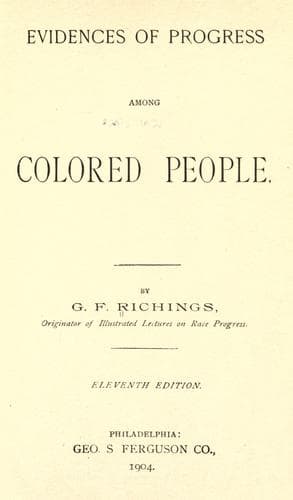
Evidences of Progress Among Colored PeopleRichings, G. F.
History
Evidences of Progress Among Colored People
Richings, G. F.
African Americans
The literary work will compare most favorably with that done in
other like institutions of the best grades. The students have taught
in this State and in other States and are much in demand. It is a
Christian centre and is giving a thorough Christian training to all
of its students. Its industrial and domestic departments are giving
such training as will revolutionize the home life, give intelligent
direction to the applied hand, and give business-like system to all the
activities. The present year marks the most interesting and prosperous
one in its history. All the rooms in the girls' dormitory are occupied,
and no place can be found for the boys. The great, pressing and
immediate want of the institution, is a dormitory for the boys. With
this want supplied, the ability of the school to do a much-needed and
urgent work for Christ and humanity will be increased many fold. Few
schools under the auspices of the _Freedmen's Board_ have a better
field and a better opportunity to do a great, useful and permanent work
for a needy, meritorious, and appreciative people. With timely and
sufficient aid, few schools have a brighter, more fruitful, or a more
glorious future. The faculty of the school is as follows:
Rev. W. H. Franklin, A. M., Mr. J. J. Johnson, A. B., Miss Ada G.
Battle, N. S., Mrs. Flora E. Elms, N., Mrs. Ida V. Penland Love, N.,
and Mrs. Laura C. Franklin, Matron.
REV. W. H. FRANKLIN.
[Illustration: REV. W. H. FRANKLIN, A. M.]
Rev. W. H. Franklin, A. M., was born at Knoxville, Tenn., April 14,
1852. His parents were free and enjoyed the respect and confidence
of all who knew them. His father was a competent brick mason and
was much in demand in his trade. His mother is a modest and sensible
woman. The ancestors of both parents were influential. His grandmother,
with several members of her family, went to Liberia in 1850. Mr.
Franklin had the opportunity of attending school one month, just as
the Rebellion began. He learned to read and to write his name in that
month. When Burnside came to Knoxville in 1865, he entered school
again. He was generally acknowledged not only the head of his class,
but also the head of the school he attended. He attended the schools of
Knoxville until 1870. He then taught school at Hudsonville, Marshall
Co., Miss., for two terms and saved sufficient money to help build a
better house for his mother and to enter Maryville College, Maryville,
Tenn. In that institution he took high rank in his class, and in the
college. His talents received immediate recognition. The first year he
appeared as Vice-President of the Athenian Society and a participant
in its annual exercises, delivering a recitation and the diplomas to
the graduates of the society. From that time his recognition and place
was secured until his graduation in 1880 from the classical course.
His graduating oration was said to be the best on the occasion. He
entered Lane Theological Seminary in Sept., 1880, and graduated from
Public-domain text, read in full here on John Shaqi.
Reviews
Reviews
No reviews yet
Be the first to share your thoughts on this work.
Elsewhere in the archive
Join the Discussion
Join the discussion
Sign in to leave a comment or review.
Sign InorCreate an account