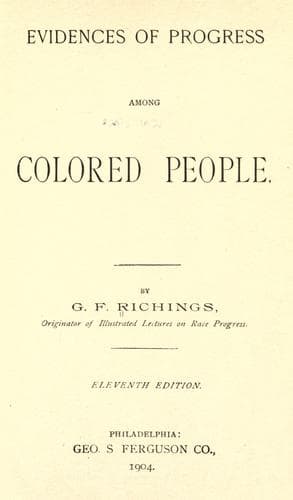
Evidences of Progress Among Colored PeopleRichings, G. F.
History
Evidences of Progress Among Colored People
Richings, G. F.
African Americans
Perhaps the phase of this question which has aroused the greatest
discussion is, "What kind of education does the Negro need?" Yet,
probably, if we would try better to understand each other, there
would be less difference of opinion. He who claims that there are
those who should receive the higher education, and he who contends
that what the masses need is an English course and a trade, are not
necessarily antagonistic in their views. They may simply stand each
for the prominent presentation of a special phase of the work to be
done for the race. Bright colored girls and boys who wish to go to
college and can do so, certainly should be encouraged to go. We have
need of men and women with trained and disciplined minds. Besides
there are individuals who are endowed with special gifts which can be
used, to the greatest advantage, for the race and for humanity, only
by giving them the highest possible degree of culture. On the other
hand, there are the masses, who, like the masses of any race, are not
able, either intellectually or financially, to take a college course,
and who, besides, are destined to callings which require training other
than that the college gives. What is to be done for them? This Booker
T. Washington is ably demonstrating at Tuskegee. Both of these cases
should be presented in equity, and the importance of either should not
cause the other to be overlooked.
[Illustration: PROF. B. T. WASHINGTON, A. M.,
_Principal of Tuskegee Normal and Industrial Institute, Tuskegee, Ala._]
The success of the Tuskegee School is due, in a large measure, to the
fact that it meets what is recognized as a great educational need. It
carries along with the training of the head the training of the hand
makes possible an education to the poorest boy and girl in the land,
and sends each graduate out into the world familiar with some form
of labor to the extent that he can earn thereby his daily bread. The
experiment of this kind of training in solving the much-talked-of
problem, is being watched on all sides with eager curiosity.
[Illustration: ARMSTRONG HALL.
_Built by Students._]
Tuskegee is no more Hampton than Hampton is the little school in the
Sandwich Islands, from which General Armstrong received those earliest
conceptions of the industrial education, afterwards realized on
American soil in behalf of the American Negro. The peculiar exigencies
of the situation gave rise to features in the more Southern school
which are not to be found in the one nearer Mason and Dixon's line,
and, in like manner, account for the absence in the younger school, of
certain characteristics belonging to the older institution.
Public-domain text, read in full here on John Shaqi.
Reviews
Reviews
No reviews yet
Be the first to share your thoughts on this work.
Elsewhere in the archive
Join the Discussion
Join the discussion
Sign in to leave a comment or review.
Sign InorCreate an account