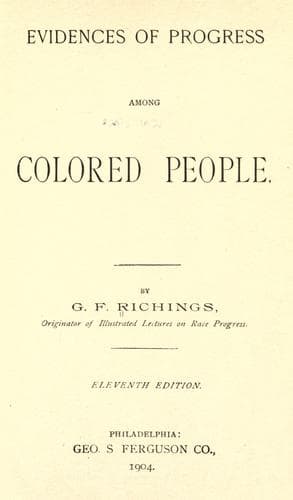
Evidences of Progress Among Colored PeopleRichings, G. F.
History
Evidences of Progress Among Colored People
Richings, G. F.
African Americans
Its session for 1896 opened with students from fourteen different
States, and with prospects bright and encouraging. Students who enter
this University must come with a purpose and must use with profit their
time. Anything short of this will not be tolerated.
[Illustration: Eckstein Norton Conservatory of Music Cane Spring Ky.]
Children who come as young as eight years are under a special matron
who cares for them as a mother. In the Industrial Department will
be found carpentry, blacksmithing, farming, printing, plain sewing,
dressmaking, tailoring, cooking, etc. Business Department includes
Shorthand, Typewriting, Bookkeeping, etc.
The Musical Conservatory is the first of the race manned by teachers
from the best Conservatories of Music of this country. The course
of study is in accord with Oberlin, Boston, Chicago and others. A
Conservatory building is now being erected under the direction of
Prof. Hattie A. Gibbs, who has traveled extensively through the East in
its interest.
Many of the graduates who have gone out from this institution are
successfully teaching in the various districts of their counties, and
some are assistants in the schools of their towns. Many of these young
men and women return after their schools close and take up their duties
in the College Department. Classes and studies are so arranged that
students may study what is most desirable, leave off at any stage,
recruit their health or finances, and return to complete the course at
any future time. The time to finish any course is the least possible,
consistent with thorough work in all departments. The school recognizes
annually the 16th of December (birthday of Honorable Eckstein Norton,
after whom the school is named), Donor's Day, at which time the work
is reviewed and the memory of those who have helped the institution,
living or dead, is kept fresh and revered by students and friends;
letters of encouragement are read and contributions announced.
The faculty is competent and consists of the following persons:
Rev. C. H. Parrish, A. B., A. M., President; P. T. Frazier, A. B; Mary
V. Cook, A. B., A. M.; Alice P. Kelley, A. B., A. M.; Hattie A. Gibbs,
Oberlin Conservatory; Minnetta B. James, Minnesota; Cornelia Burk,
Virginia; Amanda V. Nelson, Matron.
REV. CHARLES HENRY PARRISH, A. B., A. M.
One of the most remarkable men among the Negro educators of this
country is Rev. C. H. Parrish. He is a native Kentuckian, and worked
his way up from errand boy in a dry goods store to the presidency of a
flourishing school, and one of the most noted ministers in the Baptist
denomination. In infancy his mother beheld a son in whom her soul could
delight. Obedient, true and faithful were traits in his character so
conspicuous that he was a favorite in his town among all people.
Public-domain text, read in full here on John Shaqi.
Reviews
Reviews
No reviews yet
Be the first to share your thoughts on this work.
Elsewhere in the archive
Join the Discussion
Join the discussion
Sign in to leave a comment or review.
Sign InorCreate an account