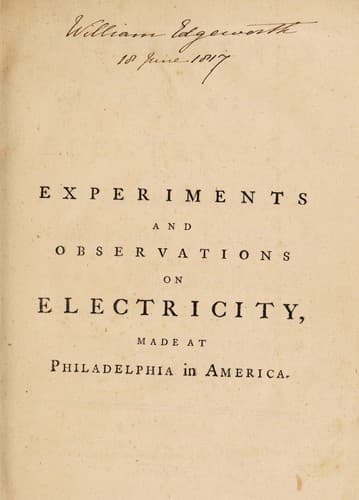
Experiments and Observations on Electricity Made at Philadelphia in AmericaFranklin, Benjamin
History
Experiments and Observations on Electricity Made at Philadelphia in America
Franklin, Benjamin
Electricity -- Early works to 1850
28. In order to this, let it first be considered, _that we cannot, by any
means we are yet acquainted with, force the electrical fluid thro' glass_.
I know it is commonly thought that it easily pervades glass, and the
experiment of a feather suspended by a thread in a bottle hermetically
sealed, yet moved by bringing a nibbed tube near the outside of the bottle,
is alledged to prove it. But, if the electrical fluid so easily pervades
glass, how does the vial become _charged_ (as we term it) when we hold it
in our hands? Would not the fire thrown in by the wire pass through to our
hands, and so escape into the floor? Would not the bottle in that case be
left just as we found it, uncharged, as we know a metal bottle so attempted
to be charged would be? Indeed, if there be the least crack, the minutest
solution of continuity in the glass, though it remains so tight that
nothing else we know of will pass, yet the extremely subtile electrical
fluid flies through such a crack with the greatest freedom, and such a
bottle we know can never be charged: What then makes the difference between
such a bottle and one that is sound, but this, that the fluid can pass
through the one, and not through the other?[8]
29. It is true there is an experiment that at first sight would be apt to
satisfy a slight observer, that the fire thrown into the bottle by the
wire, does really pass thro' the glass. It is this: place the bottle on a
glass stand, under the prime conductor; suspend a bullet by a chain from
the prime conductor, till it comes within a quarter of an inch right over
the wire of the bottle; place your knuckle on the glass stand, at just the
same distance from the coating of the bottle, as the bullet is from its
wire. Now let the globe be turned, and you see a spark strike from the
bullet to the wire of the bottle, and the same instant you see and feel an
exactly equal spark striking from the coating on your knuckle, and so on
spark for spark. This looks as if the whole received by the bottle was
again discharged from it. And yet the bottle by this means is charged![9]
And therefore the fire that thus leaves the bottle, though the same in
quantity, cannot be the very same fire that entered at the wire; for if it
were, the bottle would remain uncharged.
30. If the fire that so leaves the bottle be not the same that is thrown in
through the wire, it must be fire that subsisted in the bottle, (that is,
in the glass of the bottle) before the operation began.
31. If so, there must be a great quantity in glass, because a great
quantity is thus discharged even from very thin glass.
Public-domain text, read in full here on John Shaqi.
Reviews
Reviews
No reviews yet
Be the first to share your thoughts on this work.
Join the Discussion
Join the discussion
Sign in to leave a comment or review.
Sign InorCreate an account