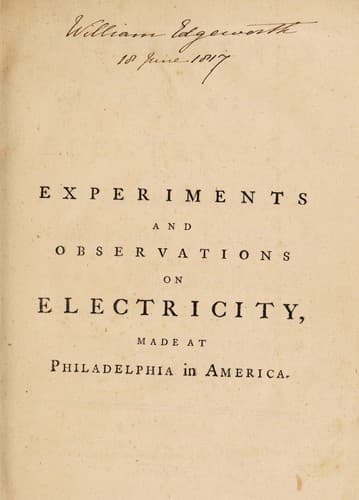
Experiments and Observations on Electricity Made at Philadelphia in AmericaFranklin, Benjamin
History
Experiments and Observations on Electricity Made at Philadelphia in America
Franklin, Benjamin
Electricity -- Early works to 1850
10 the upper corner a right angle, the two next obtuse angles, and the
lowest a very acute one; and bring this on your plate under the electrified
plate, in such a manner as that the right-angled part may be first raised
(which is done by covering the acute part with the hollow of your hand) and
you will see this leaf take place much nearer to the upper than to the
under plate; because, without being nearer, it cannot receive so fast at
its right-angled point, as it can discharge at its acute one. Turn this
leaf with the acute part uppermost, and then it takes place nearest the
unelectrified plate, because otherwise it receives faster at its acute
point than it can discharge at its right-angled one. Thus the difference of
distance is always proportioned to the difference of acuteness. Take care
in cutting your leaf to leave no little ragged particles on the edges,
which sometimes form points where you would not have them. You may make
this figure so acute below and blunt above, as to need no under plate, it
discharging fast enough into the air. When it is made narrower, as the
figure between the pricked lines, we call it the _Golden Fish_, from its
manner of acting. For if you take it by the tail, and hold it at a foot or
greater horizontal distance from the prime conductor, it will, when let go,
fly to it with a brisk but wavering motion, like that of an eel through the
water; it will then take place under the prime conductor, at perhaps a
quarter or half an inch distance, and keep a continual shaking of its tail
like a fish, so that it seems animated. Turn its tail towards the prime
conductor, and then it flies to your finger, and seems to nibble it. And if
you hold a plate under it at six or eight inches distance, and cease
turning the Globe, when the electrical atmosphere of the conductor grows
small, it will descend to the plate and swim back again several times with
the same fish-like motion, greatly to the entertainment of spectators. By a
little practice in blunting or sharpening the heads or tails of these
figures, you may make them take place as desired, nearer, or farther from
the electrified plate.
27. It is said in section 8, of this paper, that all kinds of common matter
are supposed not to attract the electrical fluid with equal strength; and
that those called electrics _per se_, as glass, &c. attract and retain it
strongest, and contain the greatest quantity. This latter position may seem
a paradox to some, being contrary to the hitherto received opinion; and
therefore I shall now endeavour to explain it.
Public-domain text, read in full here on John Shaqi.
Reviews
Reviews
No reviews yet
Be the first to share your thoughts on this work.
Join the Discussion
Join the discussion
Sign in to leave a comment or review.
Sign InorCreate an account