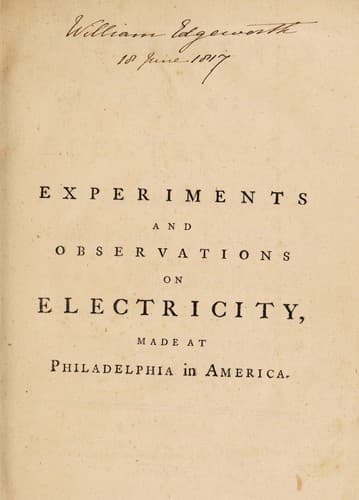
Experiments and Observations on Electricity Made at Philadelphia in America — John Shaqi
Experiments and Observations on Electricity Made at Philadelphia in AmericaFranklin, Benjamin
History
Experiments and Observations on Electricity Made at Philadelphia in America
Franklin, Benjamin
Electricity -- Early works to 1850
32. That this electrical fluid or fire is strongly attracted by glass, we
know from the quickness and violence with which it is resumed by the part
that had been deprived of it, when there is an opportunity. And by this,
that we cannot from a mass of glass draw a quantity of electrical fire, or
electrify the whole mass _minus_, as we can a mass of metal. We cannot
lessen or increase its whole quantity, for the quantity it has it holds;
and it has as much as it can hold. Its pores are filled with it as full as
the mutual repellency of the particles will admit; and what is already in,
refuses, or strongly repels, any additional quantity. Nor have we any way
of moving the electrical fluid in glass, but one; that is, by covering part
of the two surfaces of thin glass with non-electrics, and then throwing an
additional quantity of this fluid on one surface, which spreading in the
non-electric, and being bound by it to that surface, acts by its repelling
force on the particles of the electrical fluid contained in the other
surface, and drives them out of the glass into the non-electric on that
side, from whence they are discharged, and then those added on the charged
side can enter. But when this is done, there is no more in the glass, nor
less than before, just as much having left it on one side as it received on
the other.
[Illustration]
33. I feel a want of terms here, and doubt much whether I shall be able to
make this part intelligible. By the word _surface_, in this case, I do not
mean mere length and breadth without thickness; but when I speak of the
upper or under surface of a piece of glass, the outer or inner surface of
the vial, I mean length, breadth, and half the thickness, and beg the
favour of being so understood. Now, I suppose, that glass in its first
principles, and in the Furnace, has no more of this electrical fluid than
other common matter: That when it is blown, as it cools, and the particles
of common fire leave it, its pores become a vacuum: That the component
parts of glass are extremely small and fine, I guess from its never showing
a rough face when it breaks, but always a polish; and from the smallness of
its particles I suppose the pores between them must be exceeding small,
which is the reason that Aqua-fortis, nor any other menstruum we have, can
enter to separate them and dissolve the substance; nor is any fluid we know
of, fine enough to enter, except common fire, and the electrical fluid. Now
the departing fire leaving a vacuum, as aforesaid, between these pores,
which air nor water are fine enough to enter and fill, the electrical fluid
(which is every where ready in what we call the non-electrics, and in the
non-electric Mixtures that are in the air,) is attracted in: yet does not
become fixed with the substance of the glass, but subsists there as water
in a porous stone, retained only by the attraction of the fixed parts,
itself still loose and a fluid. But I suppose farther, that in the cooling
Public-domain text, read in full here on John Shaqi.
Reviews
Reviews
No reviews yet
Be the first to share your thoughts on this work.
Join the Discussion
Join the discussion
Sign in to leave a comment or review.
Sign InorCreate an account