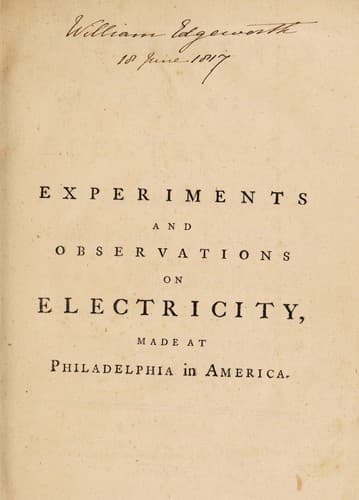
Experiments and Observations on Electricity Made at Philadelphia in AmericaFranklin, Benjamin
History
Experiments and Observations on Electricity Made at Philadelphia in America
Franklin, Benjamin
Electricity -- Early works to 1850
of the glass, its texture becomes closest in the middle, and forms a kind
of partition, in which the pores are so narrow, that the particles of the
electrical fluid, which enter both surfaces at the same time, cannot go
through, or pass and repass from one surface to the other, and so mix
together; yet, though the particles of electrical fluid, imbibed by each
surface, cannot themselves pass through to those of the other, their
repellency can, and by this means they act on one another. The particles of
the electrical fluid have a mutual repellency, but by the power of
attraction in the glass they are condensed or forced nearer to each other.
When the glass has received and, by its attraction, forced closer together
so much of this electrified fluid, as that the power of attracting and
condensing in the one, is equal to the power of expansion in the other, it
can imbibe no more, and that remains its constant whole quantity; but each
surface would receive more, if the repellency of what is in the opposite
surface did not resist its entrance. The quantities of this fluid in each
surface being equal, their repelling action on each other is equal; and
therefore those of one surface cannot drive out those of the other: but, if
a greater quantity is forced into one surface than the glass would
naturally draw in; this increases the repelling power on that side, and
overpowering the attraction on the other, drives out part of the fluid that
had been imbibed by that surface, if there be any non-electric ready to
receive it: such there is in all cases where glass is electrified to give a
shock. The surface that has been thus emptied by having its electrical
fluid driven out, resumes again an equal quantity with violence, as soon as
the glass has an opportunity to discharge that over-quantity more than it
could retain by attraction in its other surface, by the additional
repellency of which the vacuum had been occasioned. For experiments
favouring (if I may not say confirming) this hypothesis, I must, to avoid
repetition, beg leave to refer you back to what is said of the electrical
phial in my former papers.
Public-domain text, read in full here on John Shaqi.
Reviews
Reviews
No reviews yet
Be the first to share your thoughts on this work.
Join the Discussion
Join the discussion
Sign in to leave a comment or review.
Sign InorCreate an account