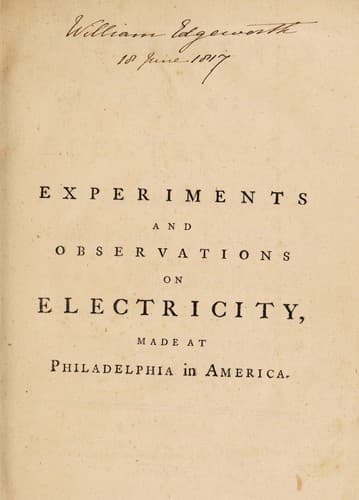
Experiments and Observations on Electricity Made at Philadelphia in AmericaFranklin, Benjamin
History
Experiments and Observations on Electricity Made at Philadelphia in America
Franklin, Benjamin
Electricity -- Early works to 1850
34. Let us now see how it will account for several other
appearances.--Glass, a body extremely elastic (and perhaps its elasticity
may be owing in some degree to the subsisting of so great a quantity of
this repelling fluid in its pores) must, when rubbed, have its rubbed
surface somewhat stretched, or its solid parts drawn a little farther
asunder, so that the vacancies in which the electrical fluid resides,
become larger, affording room for more of that fluid, which is immediately
attracted into it from the cushion or hand rubbing, they being supply'd
from the common stock. But the instant the parts of the glass so open'd and
fill'd have pass'd the friction, they close again, and force the additional
quantity out upon the surface, where it must rest till that part comes
round to the cushion again, unless some non electric (as the prime
conductor) first presents to receive it.[10] But if the inside of the globe
be lined with a non-electric, the additional repellency of the electrical
fluid, thus collected by friction on the rubb'd part of the globe's outer
surface, drives an equal quantity out of the inner surface into that
non-electric lining, which receiving it, and carrying it away from the
rubb'd part into the common mass, through the axis of the globe and frame
of the machine, the new collected electrical fluid can enter and remain in
the outer surface, and none of it (or a very little) will be received by
the prime conductor. As this charg'd part of the globe comes round to the
cushion again, the outer surface delivers its overplus fire into the
cushion, the opposite inner surface receiving at the same time an equal
quantity from the floor. Every electrician knows that a globe wet within
will afford little or no fire, but the reason has not before been attempted
to be given, that I know of.
Public-domain text, read in full here on John Shaqi.
Reviews
Reviews
No reviews yet
Be the first to share your thoughts on this work.
Join the Discussion
Join the discussion
Sign in to leave a comment or review.
Sign InorCreate an account