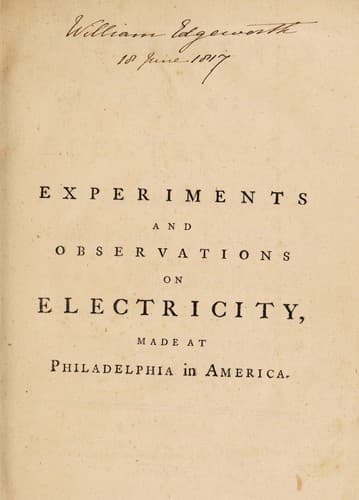
Experiments and Observations on Electricity Made at Philadelphia in AmericaFranklin, Benjamin
History
Experiments and Observations on Electricity Made at Philadelphia in America
Franklin, Benjamin
Electricity -- Early works to 1850
appearance I have yet seen, in which glass and electricity are concern'd,
are, I think, explain'd with equal ease by the same hypothesis. Yet,
perhaps, it may not be a true one, and I shall be obliged to him that
affords me a better.
35. Thus I take the difference between non electrics and glass, an electric
_per se_, to consist in these two particulars. 1st, That a non-electric
easily suffers a change in the quantity of the electrical fluid it
contains. You may lessen its whole quantity by drawing out a part, which
the whole body will again resume; but of glass you can only lessen the
quantity contain'd in one of its surfaces; and not that, but by supplying
an equal quantity at the same time to the other surface; so that the whole
glass may always have the same quantity in the two surfaces, their two
different quantities being added together. And this can only be done in
glass that is thin; beyond a certain thickness we have yet no power that
can make this change. And, 2dly, that the electrical fire freely removes
from place to place, in and through the substance of a non-electric, but
not so through the substance of glass. If you offer a quantity to one end
of a long rod of metal, it receives it, and when it enters, every particle
that was before in the rod, pushes its neighbour quite to the further end,
where the overplus is discharg'd; and this instantaneously where the rod is
part of the circle in the experiment of the shock. But glass, from the
smallness of its pores, or stronger attraction of what it contains, refuses
to admit so free a motion; a glass rod will not conduct a shock, nor will
the thinnest glass suffer any particle entring one of its surfaces to pass
thro' to the other.
Public-domain text, read in full here on John Shaqi.
Reviews
Reviews
No reviews yet
Be the first to share your thoughts on this work.
Join the Discussion
Join the discussion
Sign in to leave a comment or review.
Sign InorCreate an account