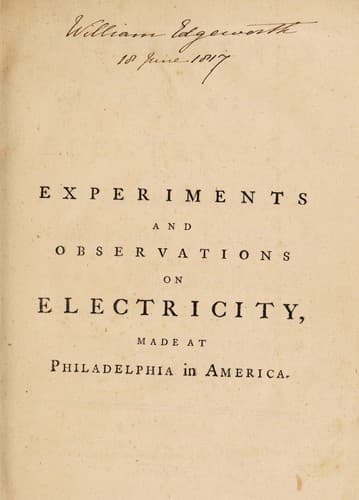
Experiments and Observations on Electricity Made at Philadelphia in AmericaFranklin, Benjamin
History
Experiments and Observations on Electricity Made at Philadelphia in America
Franklin, Benjamin
Electricity -- Early works to 1850
34. So if a tube lined with a [11]non-electric, be rubb'd, little or no
fire is obtained from it. What is collected from the hand in the downward
rubbing stroke, entering the pores of the glass, and driving an equal
quantity out of the inner surface into the non-electric lining: and the
hand in passing up to take a second stroke, takes out again what had been
thrown into the outer surface, and then the inner surface receives back
again what it had given to the non-electric lining. Thus the particles of
electrical fluid belonging to the inside surface go in and out of their
pores every stroke given to the tube. Put a wire into the tube, the inward
end in contact with the non-electric lining, so it will represent the
_Leyden_ bottle. Let a second person touch the wire while you rub, and the
fire driven out of the inward surface when you give the stroke, will pass
through him into the common mass, and return through him when the inner
surface resumes its quantity, and therefore this new kind of _Leyden_
bottle cannot so be charged. But thus it may: after every stroke, before
you pass your hand up to make another, let the second person apply his
finger to the wire, take the spark, and then withdraw his finger; and so on
till he has drawn a number of sparks; thus will the inner surface be
exhausted, and the outer surface charged; then wrap a sheet of gilt paper
close round the outer surface, and grasping it in your hand you may receive
a shock by applying the finger of the other hand to the wire: for now the
vacant pores in the inner surface resume their quantity, and the
overcharg'd pores in the outer surface discharge that overplus; the
equilibrium being restored through your body, which could not be restored
through the glass.[12] If the tube be exhausted of air, a non electric
lining in contact with the wire is not necessary; for _in vacuo_, the
electrical fire will fly freely from the inner surface, without a
non-electric conductor: but air resists its motion; for being itself an
electric _per se_, it does not attract it, having already its quantity. So
the air never draws off an electric atmosphere from any body, but in
proportion to the non-electrics mix'd with it: it rather keeps such an
atmosphere confin'd, which from the mutual repulsion of its particles,
tends to dissipation, and would immediately dissipate _in vacuo_.--And thus
the experiment of the feather inclosed in a glass vessel hermetically
sealed, but moving on the approach of the rubbed tube, is explained: When
an additional quantity of the electrical fluid is applied to the side of
the vessel by the atmosphere of the tube, a quantity is repelled and driven
out of the inner surface of that side into the vessel, and there affects
the feather, returning again into its pores, when the tube with its
atmosphere is withdrawn; not that the particles of that atmosphere did
themselves pass through the glass to the feather.----And every other
Public-domain text, read in full here on John Shaqi.
Reviews
Reviews
No reviews yet
Be the first to share your thoughts on this work.
Join the Discussion
Join the discussion
Sign in to leave a comment or review.
Sign InorCreate an account