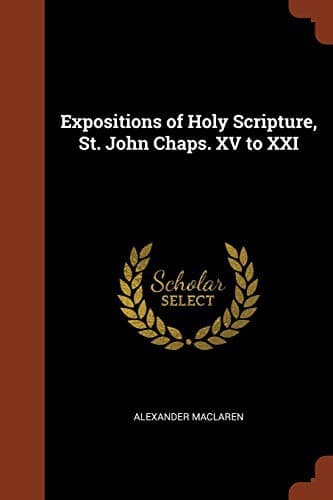
Expositions of Holy Scripture: St. John Chaps. XV to XXIMaclaren, Alexander
Religion
Expositions of Holy Scripture: St. John Chaps. XV to XXI
Maclaren, Alexander
Bible. John -- Commentaries
Pilate is getting tired of fencing, and impatiently answers, with true
Roman contempt for subject-people's thoughts as well as their weapons.
'I ... a Jew?' is said with a curl of the firm lips. He points to his
informants, 'Thine own nation and the chief priests,' and does not say
that their surrender of a would-be leader in a war of independence
struck him as suspicious. But he brushes aside the cobwebs which he
felt were being spun round him, and comes to the point, 'What hast Thou
done?' He is supremely indifferent to ideas and vagaries of
enthusiasts. This poor man before him may call Himself anything He
chooses, but _his_ only concern is with overt acts. Strange to ask the
Prisoner what He had done! It had been well for Pilate if he had held
fast by that question, and based his judgment resolutely on its answer!
He kept asking it all through the case, he never succeeded in getting
an answer; he was convinced that Jesus had done nothing worthy of
death, and yet fear, and a wish to curry favour with the rulers, drove
him to stain the judge's robe with innocent blood, from which he vainly
sought to cleanse his hands.
Our Lord's double answer claims a kingdom, but first shows what it is
not, and then what it is. It is 'not _of_ this world,' though it is
_in_ this world, being established and developed here, but having
nothing in common with earthly dominions, nor being advanced by their
weapons or methods. Pilate could convince himself that this 'kingdom'
bore no menace to Rome, from the fact that no resistance had been
offered to Christ's capture. But the principle involved in these great
words goes far beyond their immediate application. It forbids Christ's
'servants' to assimilate His kingdom to the world, or to use worldly
powers as the means for the kingdom's advancement. The history of the
Church has sadly proved how hard it is for Christian men to learn the
lesson, and how fatal to the energy and purity of the Church the
forgetfulness of it has been. The temptation to such assimilation
besets all organised Christianity, and is as strong to-day as when
Constantine gave the Church the paralysing gift of 'establishing' it as
a kingdom 'of this world.'
Pilate did pick out of this saying an increased certainty that he had
nothing to fear from this strange 'King'; and half-amused contempt for
a dreamer, and half-pitying wonder at such lofty claims from such a
helpless enthusiast, prompted his question, 'Art Thou a king then?' One
can fancy the scornful emphasis on that 'Thou.' and can understand how
grotesquely absurd the notion of his prisoner's being a king must have
seemed.
Public-domain text, read in full here on John Shaqi.
Reviews
Reviews
No reviews yet
Be the first to share your thoughts on this work.
Elsewhere in the archive
Join the Discussion
Join the discussion
Sign in to leave a comment or review.
Sign InorCreate an account