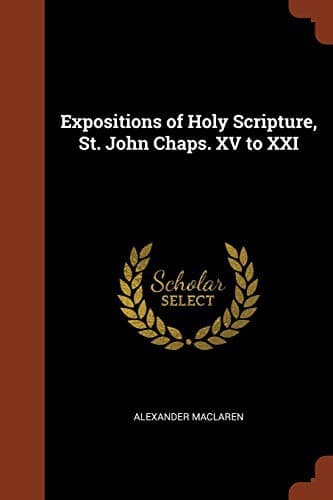
Expositions of Holy Scripture: St. John Chaps. XV to XXIMaclaren, Alexander
Religion
Expositions of Holy Scripture: St. John Chaps. XV to XXI
Maclaren, Alexander
Bible. John -- Commentaries
Christ asks for love. Surely that indicates the depth of His own! In
this commerce He is satisfied with nothing less, and can ask for
nothing more; and He seeks for love because He is love, and has given
love. Oh! to all hearts burdened, as all our hearts ought to be--unless
the burden has been cast off in one way--by the consciousness of our
own weakness and imperfection, surely, surely, it is a gospel that is
contained in that one question addressed to a man who had gone far
astray, 'Simon, son of Jonas, lovest thou?'
Here, again, we have Jesus Christ, in His dealing with the penitent,
willing to trust discredited professions. We think that one of the
signs of our being wise people is that experience shall have taught us
'once' being 'bit, twice' to be 'shy,' and if a man has once deceived
us by flaming professions and ice-cold acts, never to trust him any
more. And we think that is 'worldly wisdom,' and 'the bitter fruit of
earthly experience,' and 'sharpness,' and 'shrewdness,' and so forth.
Jesus Christ, even whilst reminding Peter, by that 'more than these,'
of his utterly hollow and unreliable boasting, shows Himself ready to
accept once again the words of one whose unveracity He had proved.
'Charity hopeth all things, believeth all things,' and Jesus Christ is
ready to trust us when we say, 'I love Thee,' even though often in the
past our professed love has been all disproved.
We have here, in this question, our Lord revealing Himself as willing
to accept the imperfect love which a disciple can offer Him. Of course,
many of you well know that there is a very remarkable play of
expression here. In the two first questions the word which our Lord
employs for 'love' is not the same as that which appears in Peter's two
first answers. Christ asks for one kind of love; Peter proffers
another. I do not enter upon discussion as to the distinction between
these two apparent synonyms. The kind of love which Christ asks for is
higher, nobler, less emotional, and more associated with the whole mind
and will. It is the inferior kind, the more warm, more sensuous, more
passionate and emotional, which Peter brings. And then, in the third
question, our Lord, as it were, surrenders and takes Peter's own word,
as if He had said, 'Be it so! You shrink from professing the higher
kind; I will take the lower; and I will educate and bring that up to
the height that I desire you to stand at.' Ah, brother! however stained
and imperfect, however disproved by denials, however tainted by earthly
associations, Jesus Christ will accept the poor stream of love, though
it be but a trickle when it ought to be a torrent, which we can bring
Him.
These are the lessons which it seems to me lie in this triple question.
I have dealt with them at the greater length, because those which
follow are largely dependent upon them. But let me turn now briefly, in
the second place, to--
II. The triple answer.
Public-domain text, read in full here on John Shaqi.
Reviews
Reviews
No reviews yet
Be the first to share your thoughts on this work.
Elsewhere in the archive
Join the Discussion
Join the discussion
Sign in to leave a comment or review.
Sign InorCreate an account