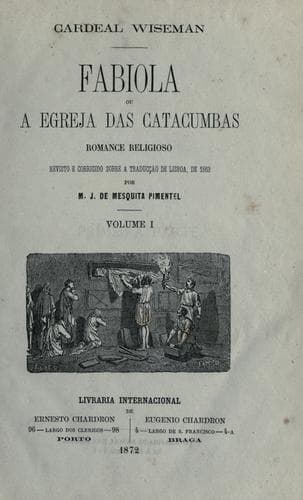
Fabiola; Or, The Church of the CatacombsWiseman, Nicholas Patrick
HistoryHistory
Fabiola; Or, The Church of the Catacombs
Wiseman, Nicholas Patrick
Christian fiction; Church history -- Primitive and early church, ca. 30-600 -- Fiction; Historical fiction
We here see how a foreigner, reading these two inscriptions, with the
portraits, and knowing that the Church commemorates the two martyrs on
the same day, might easily be led to suppose that they were here
deposited together. Finally at the right hand of the tomb stands a
truncated column, about three feet high, concave at the top, as before
described; and as a confirmation of the use to which we said it might be
put, St. Gregory has, in his list of oils sent to the Lombard Queen,
“Oleum S. Cornelii,” the oil of St. Cornelius.
We see, then, how, during the second period, new ornaments, as well as
greater conveniences, were added to the primitively simple forms of the
cemeteries. But we must not, on that account, imagine that we are in any
danger of mistaking these later embellishments for the productions of
the early ages. The difference is so immense that we might as easily
blunder by taking a Rubens for a Beato Angelico, as by considering a
Byzantine figure to be a production of the two first centuries.
We come now to the third period of these holy cemeteries, the sad one of
their desolation. When the Lombards, and later the Saracens, began to
devastate the neighborhood of Rome, and the catacombs were exposed to
desecration, the popes extracted the bodies of the most illustrious
martyrs, and placed them in the basilicas of the city. This went on till
the eighth or ninth century; when we still read of repairs made in the
cemeteries by the sovereign pontiffs. The catacombs ceased to be so much
places of devotion; and the churches, which stood over their entrances,
were destroyed, or fell to decay. Only those remained which were
fortified, and could be defended. Such are the extramural basilicas of
St. Paul on the Ostian way, of St. Sebastian on the Appian, St. Laurence
on the Tiburtine, or in the Ager Veranus, St. Agnes on the Nomentan
road, St. Pancratius on the Aurelian, and, greatest of all, St. Peter’s
on the Vatican. The first and last had separate _burghs_ or cities round
them; and the traveller can still trace remains of strong walls round
some of the others.
Public-domain text, read in full here on John Shaqi.
Reviews
Reviews
No reviews yet
Be the first to share your thoughts on this work.
Elsewhere in the archive
Join the Discussion
Join the discussion
Sign in to leave a comment or review.
Sign InorCreate an account