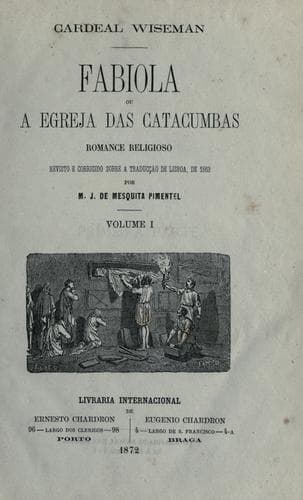
Fabiola; Or, The Church of the CatacombsWiseman, Nicholas Patrick
HistoryHistory
Fabiola; Or, The Church of the Catacombs
Wiseman, Nicholas Patrick
Christian fiction; Church history -- Primitive and early church, ca. 30-600 -- Fiction; Historical fiction
“Come, come along,” he said, “or we shall lose sight of the rest, and
not see which way they turn. That little niche is to hold a lamp; you
will find one at each angle. As to ourselves, we know every alley and
turn here below, as you do those of the city above.”
[Illustration: A Lamp with a representation of the Good Shepherd, found
at Ostium prior to the third century. From Roller’s “Catacombes.”]
Torquatus was somewhat reassured by this account of the lamps--those
little earthen ones, evidently made on purpose for the catacombs, of
which so many are there found. But not content, he kept as good count as
he could of the turns, as they went; and now with one excuse, and now
with another, he constantly stopped, and scrutinized particular spots
and corners. But Severus had a lynx’s eye upon him, and allowed nothing
to escape his attention.
At last they entered a doorway, and found themselves in a square
chamber, richly adorned with paintings.
“What do you call this?” asked Tiburtius.
“It is one of the many crypts, or _cubicula_,[101] which abound in our
cemeteries,” answered Diogenes; “sometimes they are merely family
sepultures, but generally they contain the tomb of some martyr, on whose
anniversary we meet here. See that tomb opposite us, which, though flush
with the wall, is arched over. That becomes, on such an occasion, the
altar whereon the Divine mysteries are celebrated. You are of course
aware of the custom of so performing them.”
[Illustration: Cubiculum or Crypt, as found in the Catacombs.]
“Perhaps my two friends,” interposed Pancratius, “so recently baptized,
may not have heard it; but I know it well. It is surely one of the
glorious privileges of martyrdom, to have the Lord’s sacred Body and
precious Blood offered upon one’s ashes, and to repose thus under the
very feet of God.[102] But let us see well the paintings all over this
crypt.”
[Illustration: The Last Supper. From a picture in the Cemetery of St.
Callistus.]
“It is on account of them that I brought you into this chamber, in
preference to so many others in the cemetery. It is one of the most
ancient, and contains a most complete series of pictures, from the
remotest times down to some of my son’s doing.”
“Well, then, Diogenes, explain them systematically to my friends,” said
Pancratius. “I think I know most of them, but not all; and I shall be
glad to hear you describe them.”
“I am no scholar,” replied the old man, modestly, “but when one has
lived sixty years, man and boy, among things, one gets to know them
better than others, because one loves them more. All here have been
fully initiated, I suppose?” he added, with a pause.
“All,” answered Tiburtius, “though not so fully instructed as converts
ordinarily are. Torquatus and myself have received the sacred gift.”
[Illustration: A Ceiling in the Catacombs. From De Rossi’s “Roma
Sotteranea.”]
Public-domain text, read in full here on John Shaqi.
Reviews
Reviews
No reviews yet
Be the first to share your thoughts on this work.
Elsewhere in the archive
Join the Discussion
Join the discussion
Sign in to leave a comment or review.
Sign InorCreate an account