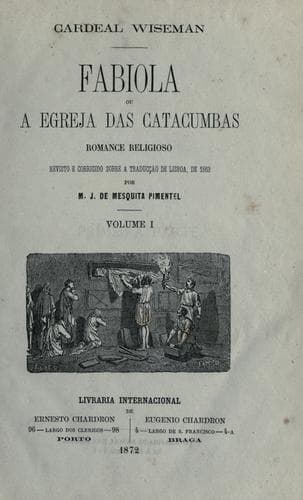
Fabiola; Or, The Church of the CatacombsWiseman, Nicholas Patrick
HistoryHistory
Fabiola; Or, The Church of the Catacombs
Wiseman, Nicholas Patrick
Christian fiction; Church history -- Primitive and early church, ca. 30-600 -- Fiction; Historical fiction
All admired the painting; but poor Severus was much chagrined at seeing
how his good father had unwittingly supplied the information desired by
Torquatus, and had furnished him with a sure clue to the desired turn,
by calling his attention to the tomb close round it, distinguishable by
so remarkable a picture.
When their company was departed, he told all that he had observed to his
brother, remarking, “That man will give us trouble yet: I strongly
suspect him.”
In a short time they had removed every mark which Torquatus had made at
the turnings. But this was no security against his reckonings; and they
determined to prepare for changing the road, by blocking up the present
one, and turning off at another point. For this purpose they had the
sand of new excavations brought to the ends of a gallery which crossed
the main avenue, where this was low, and left it heaped up there till
the faithful could be instructed of the intended change.
[Illustration: Moses striking the rock, from the Cemetery of “Inter duos
Lauros.”]
CHAPTER V.
ABOVE GROUND.
To recover our reader from his long subterranean excursion, we must take
him with us on another visit, to the “happy Campania,” or, “Campany the
blest,” as an old writer might have called it. There we left Fabiola
perplexed by some sentences which she had found. They came to her like a
letter from another world; she hardly knew of what character. She wished
to learn more about them, but she hardly durst inquire. Many visitors
called the next day, and for several days after, and she often thought
of putting before some or other of them the mysterious sentences, but
she could not bring herself to do it.
A lady, whose life was like her own, philosophically correct, and coldly
virtuous, came; and they talked together over the fashionable opinions
of the day. She took out her vellum page to puzzle her; but she shrank
from submitting it to her: it felt profane to do so. A learned man, well
read in all branches of science and literature, paid her a long visit,
and spoke very charmingly on the sublimer views of the older schools.
She was tempted to consult _him_ about her discovery; but it seemed to
contain something higher than he could comprehend. It was strange that,
after all, when wisdom or consolation was to be sought, the noble and
haughty Roman lady should turn instinctively to her Christian slave. And
so it was now. The first moment they were alone, after several days of
company and visits, Fabiola produced her parchment, and placed it before
Syra. There passed over her countenance an emotion not observable to her
mistress; but she was perfectly calm, as she looked up from reading.
“That writing,” said her mistress, “I got at Chromatius’s villa, on the
back of a note, probably by mistake. I cannot drive it out of my mind,
which is quite perplexed by it.”
“Why should it be so, my noble lady? Its sense seems plain enough.”
Public-domain text, read in full here on John Shaqi.
Reviews
Reviews
No reviews yet
Be the first to share your thoughts on this work.
Elsewhere in the archive
Join the Discussion
Join the discussion
Sign in to leave a comment or review.
Sign InorCreate an account