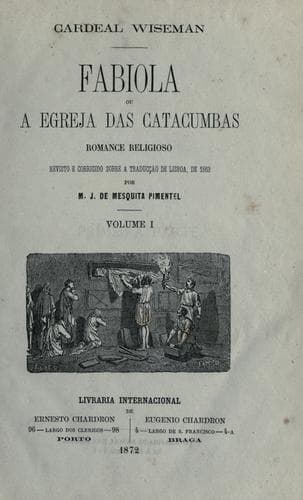
Fabiola; Or, The Church of the CatacombsWiseman, Nicholas Patrick
HistoryHistory
Fabiola; Or, The Church of the Catacombs
Wiseman, Nicholas Patrick
Christian fiction; Church history -- Primitive and early church, ca. 30-600 -- Fiction; Historical fiction
“Well, then, the principle of that system which I profess is this: that
we must treat and practise, as every-day and common virtue, nay, as
simple duty, whatever any other code, the purest and sublimest that may
be, considers heroic, and proof of transcendent virtue.”
“That is indeed a sublime standard to form, of moral elevation; but mark
the difference between the two cases. The hero is supported by the
praises of the world: his act is recorded and transmitted to posterity,
when he checks his passions, and performs a sublime action. But who
sees, cares for, or shall requite, the poor obscure wretch, who in
humble secrecy imitates his conduct?”
Syra, with solemn, reverential look and gesture, raised her eyes and her
right hand to heaven, and slowly said: “His Father, who is in heaven,
who maketh His sun to rise on the good and the bad, and raineth on the
just and the unjust.”
Fabiola paused for a time, overawed: then said affectionately and
respectfully: “Again, Syra, you have conquered my philosophy. Your
wisdom is consistent as it is sublime. A virtue heroic, even when
unseen, you propose as the ordinary daily virtue of every one. Men must
indeed become more than what gods have been thought to be, to attempt
it; but the very idea is worth a whole philosophy. Can you lead me
higher than this?”
“Oh, far!--far higher still.”
“And where at length would you leave me?”
[Illustration: Monogram of Christ, found in the Catacombs.]
“Where your heart should tell you that it had found peace.”
CHAPTER VI.
DELIBERATIONS.
The persecution had now been some time raging in the East under
Dioclesian and Galerius; and the decree for enkindling it throughout the
West, had reached Maximian. But it had been resolved to make this a
work, not of repression, but of extermination, of the Christian name. It
had been determined to spare no one; but cutting off the chiefs of the
religion first, to descend down to the wholesale butchery of the poorest
classes. It was necessary for this purpose to concert measures, that the
various engines of destruction might work in cruel harmony: that every
possible instrument should be employed to secure completeness to the
effort; and also that the majesty of imperial command should add its
grandeur and its terror to the crushing blow.
For this purpose the emperor, though impatient to begin his work of
blood, had yielded to the opinion of his counsellors, that the edict
should be kept concealed till it could be published simultaneously in
every province, and government, of the West. The thundercloud, fraught
with vengeance, would thus hang for a time, in painful mystery, over its
intended victims, and then burst suddenly upon them, discharging upon
their heads its mingled elements, and its “fire, hail, snow, ice, and
boisterous blast.”
Public-domain text, read in full here on John Shaqi.
Reviews
Reviews
No reviews yet
Be the first to share your thoughts on this work.
Elsewhere in the archive
Join the Discussion
Join the discussion
Sign in to leave a comment or review.
Sign InorCreate an account