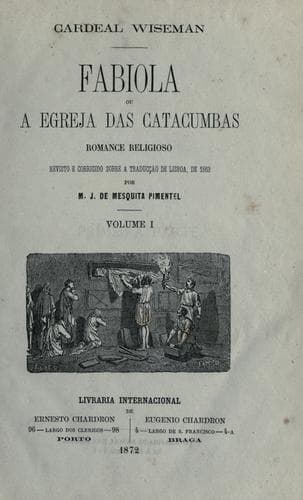
Fabiola; Or, The Church of the CatacombsWiseman, Nicholas Patrick
HistoryHistory
Fabiola; Or, The Church of the Catacombs
Wiseman, Nicholas Patrick
Christian fiction; Church history -- Primitive and early church, ca. 30-600 -- Fiction; Historical fiction
It would be attributing to Maximian a quality which he did not possess,
were we to give him credit for loving a residence so admirably situated,
through any taste for the beautiful. The splendor of the buildings,
which he had still further adorned, or possibly the facility of running
out of the city for the chase of boar and wolf, was the motive of this
preference. A native of Sirmium, in Sclavonia, a reputed barbarian
therefore of the lowest extraction, a mere soldier of fortune, without
any education, endowed with little more than a brute strength, which
made his surname of Herculeus most appropriate, he had been raised to
the purple by his brother-barbarian Diocles, known as the emperor
Dioclesian. Like him, covetous to meanness, and spendthrift to
recklessness, addicted to the same coarse vices and foul crimes, which a
Christian pen refuses to record, without restraint of any passion,
without sense of justice, or feeling of humanity, this monster had never
ceased to oppress, persecute, and slay whoever stood in his way. To him
the coming persecution looked like an approaching feast does to a
glutton, who requires the excitement of a surfeit to relieve the
monotony of daily excess. Gigantic in frame, with the well-known
features of his race, with the hair on his head and face more yellow
than red, shaggy and wild, like tufts of straw, with eyes restlessly
rolling in a compound expression of suspicion, profligacy, and ferocity,
this almost last of Rome’s tyrants struck terror into the heart of any
beholder, except a Christian. Is it wonderful that he hated the race and
its name?
In the large basilica, or hall, then, of the Ædes Lateranæ,[110]
Maximian met his motley council, in which secrecy was ensured by
penalty of death. In the semicircular apse at the upper end of the hall,
sat the emperor, on an ivory throne richly adorned, and before him were
arranged his obsequious and almost trembling advisers. A chosen body of
guards kept the entrance; and the officer in command, Sebastian, was
leaning negligently against it on the inside, but carefully noted every
word that was spoken.
Little did the emperor think, that the hall in which he sat, and which
he afterwards gave, with the contiguous palace, to Constantine, as part
of the dowry of his daughter, Fausta, would be transferred by him to the
head of the religion he was planning to extirpate, and become, retaining
its name of the Lateran Basilica, the cathedral of Rome, “of all the
churches of the city and of the world the mother and chief.”[111] Little
did he imagine, that on the spot whereon rested his throne, would be
raised a Chair, whence commands should issue, to reach worlds unknown to
Roman sway, from an immortal race of sovereigns, spiritual and temporal.
Public-domain text, read in full here on John Shaqi.
Reviews
Reviews
No reviews yet
Be the first to share your thoughts on this work.
Elsewhere in the archive
Join the Discussion
Join the discussion
Sign in to leave a comment or review.
Sign InorCreate an account