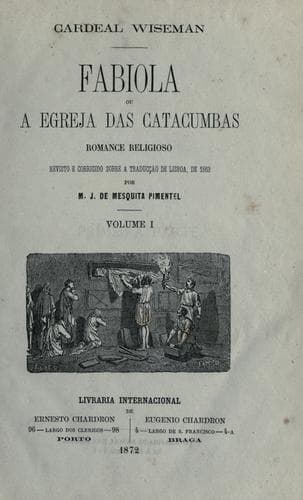
Fabiola; Or, The Church of the CatacombsWiseman, Nicholas Patrick
HistoryHistory
Fabiola; Or, The Church of the Catacombs
Wiseman, Nicholas Patrick
Christian fiction; Church history -- Primitive and early church, ca. 30-600 -- Fiction; Historical fiction
“With pleasure,” answered the old man. “It is now nearly forty-five
years since it happened,[140] and as I was older then than you are now,
you may suppose I remember all quite distinctly. He was indeed a
beautiful youth to look at: so mild and sweet, so fair and graceful; and
his speech was so gentle, so soft, especially when speaking to the poor.
How they all loved him! I followed him everywhere; I stood by as the
venerable Pontiff Sixtus was going to death, and Laurentius met him, and
so tenderly reproached him, just as a son might a father, for not
allowing him to be his companion in the sacrifice of himself, as he had
ministered to him in the sacrifice of our Lord’s body and blood.”
“Those were splendid times, Diogenes, were they not?” interrupted the
youth; “how degenerate we are now! What a different race! Are we not,
Quadratus?”
The rough soldier smiled at the generous sincerity of his complaint, and
bid Diogenes go on.
“I saw him too as he distributed the rich plate of the Church to the
poor. We have never had any thing so splendid since. There were golden
lamps and candlesticks, censors, chalices, and patens,[141] besides an
immense quantity of silver melted down, and distributed to the blind,
the lame, and the indigent.”
“But tell me,” asked Pancratius, “how did he endure his last dreadful
torment? It must have been frightful.”
“I saw it all,” answered the old fossor, “and it would have been
intolerably frightful in another. He had been first placed on the rack,
and variously tormented, and he had not uttered a groan; when the judge
ordered that horrid bed, or gridiron, to be prepared and heated. To look
at his tender flesh blistering and breaking over the fire, and deeply
scored with red burning gashes that cut to the bone where the iron bars
went across; to see the steam, thick as from a cauldron, rise from his
body, and hear the fire hiss beneath him, as he melted away into it; and
every now and then to observe the tremulous quivering that crept over
the surface of his skin, the living motion which the agony gave to each
separate muscle, and the sharp spasmodic twitches which convulsed, and
gradually contracted, his limbs; all this, I own, was the most harrowing
spectacle I have ever beheld in all my life. But to look into his
countenance was to forget all this. His head was raised up from the
burning body, and stretched out, as if fixed on the contemplation of
some most celestial vision, like that of his fellow-deacon Stephen. His
face glowed indeed with the heat below, and the perspiration flowed down
it; but the light from the fire shining upwards, and passing through his
golden locks, created a glory round his beautiful head and countenance,
which made him look as if already in heaven. And every feature, serene
and sweet as ever, was so impressed with an eager, longing look,
accompanying the upward glancing of his eye, that you would willingly
have changed places with him.”
Public-domain text, read in full here on John Shaqi.
Reviews
Reviews
No reviews yet
Be the first to share your thoughts on this work.
Elsewhere in the archive
Join the Discussion
Join the discussion
Sign in to leave a comment or review.
Sign InorCreate an account