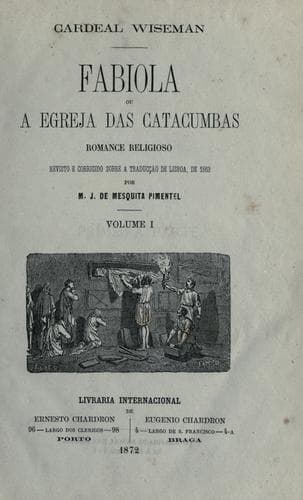
Fabiola; Or, The Church of the CatacombsWiseman, Nicholas Patrick
HistoryHistory
Fabiola; Or, The Church of the Catacombs
Wiseman, Nicholas Patrick
Christian fiction; Church history -- Primitive and early church, ca. 30-600 -- Fiction; Historical fiction
And what else, or more, would those be in a few years who had issued
that proud document, when their corpses should have been burnt on a pile
of cedar-wood and spices, and their handful of ashes be scraped
together, hardly enough to fill a gilded urn? And what also, in very few
years more, would that heathenism be, which it was issued to keep alive,
but a dead letter at most, and as worthless a heap of extinguished
embers as lay on that hearth? And the very empire which these
“unconquered” Augusti were bolstering up by cruelty and injustice, how
in a few centuries would it resemble that annihilated decree? the
monuments of its grandeur lying in ashes, or in ruins, and proclaiming
that there is no true Lord but one stronger than Cæsars, the Lord of
lords; and that neither counsel nor strength of man shall prevail
against Him.
Something like this did Sebastian think, perhaps, as he gazed
abstractedly on the expiring embers of the pompous and cruel edict which
they had torn down, not for a wanton frolic, but because it contained
blasphemies against God and His holiest truths. They knew that if they
should be discovered, tenfold tortures would be their lot; but
Christians in those days, when they contemplated and prepared for
martyrdom, made no calculation on that head. Death for Christ, whether
quick and easy, or lingering and painful, was the end for which they
looked; and, like brave soldiers going to battle, they did not speculate
where a shaft or a sword might strike them, whether a death-blow would
at once stun them out of existence, or they should have to writhe for
hours upon the ground, mutilated or pierced, to die by inches among the
heaps of unheeded slain.
Sebastian soon recovered, and had hardly the heart to reprove the
perpetrators of this deed. In truth, it had its ridiculous side, and he
was inclined to laugh at the morrow’s dismay. This view he gladly took,
for he saw Pancratius watched his looks with some trepidation, and his
centurion looked a little disconcerted. So, after a hearty laugh, they
sat down cheerfully to their meal; for it was not midnight, and the hour
for commencing the fast, preparatory to receiving the holy Eucharist,
was not arrived. Quadratus’s object, besides kindness, in this
arrangement, was partly, that if surprised, a reason for their being
there might be apparent, partly to keep up the spirits of his younger
companion and of Diogenes’s household, if alarmed at the bold deed just
performed. But there was no appearance of any such feeling. The
conversation soon turned upon recollections of Diogenes’s youth, and the
good old fervent times, as Pancratius would persist in calling them.
Sebastian saw his friend home, and then took a round, to avoid the Forum
in seeking his own abode. If any one had seen Pancratius that night,
when alone in his chamber preparing to retire to rest, he would have
seen him every now and then almost laughing at some strange but pleasant
adventure.
Public-domain text, read in full here on John Shaqi.
Reviews
Reviews
No reviews yet
Be the first to share your thoughts on this work.
Elsewhere in the archive
Join the Discussion
Join the discussion
Sign in to leave a comment or review.
Sign InorCreate an account