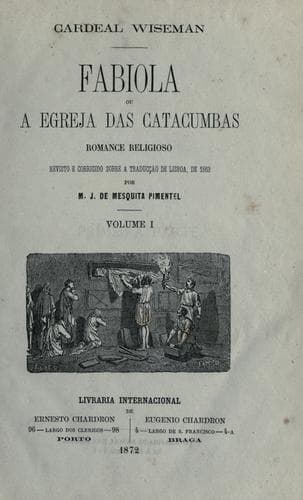
Fabiola; Or, The Church of the CatacombsWiseman, Nicholas Patrick
HistoryHistory
Fabiola; Or, The Church of the Catacombs
Wiseman, Nicholas Patrick
Christian fiction; Church history -- Primitive and early church, ca. 30-600 -- Fiction; Historical fiction
“Call it the same, to be revealed at the same time. But I can tell you
what I want you to do, and that I think will satisfy you. Corvinus has
got orders to seize on Chromatius and all his community, yet young in
the faith, as the wretched example of Torquatus has shown us; and, what
is worse, to put your old master Cassianus, at Fundi, to a cruel death.
I want you to hasten before his messenger (perhaps he may go himself),
and put them on their guard.”
Pancratius looked up brightly again; he saw that Sebastian trusted him.
“Your wish is enough reason for me,” said he, smiling; “but I would go
the world’s end to save my good Cassianus, or any other
fellow-Christians.”
He was soon ready, took an affectionate leave of his mother; and before
Rome had fully shaken off sleep, he and Quadratus, each with
well-furnished saddle-bags on their powerful steeds, were trotting
across the campagna of Rome, to reach the less-frequented, and safer,
track of the Latin way.
Corvinus having resolved to keep the hostile expedition in his own
hands, as honorable, lucrative, and pleasant, it was delayed a couple of
days, both that he might feel more comfortable about his shoulders, and
that he might make proper preparations. He had a chariot hired, and
engaged a body of Numidian runners, who could keep up with a carriage
at full speed. But he was thus two days behind our Christians, though
he, of course, travelled by the shorter and more beaten Appian road.
When Pancratius arrived at the Villa of Statues, he found the little
community already excited, by the rumors, which had reached it, of the
edict’s publication. He was welcomed most warmly by all; and Sebastian’s
letter of advice was received with deep respect. Prayer and deliberation
succeeded its perusal, and various resolutions were taken. Marcus and
Marcellianus, with their father Tranquillinus, had already gone to Rome
for the ordination. Nicostratus, Zoë, and others followed them now.
Chromatius, who was not destined for the crown of martyrdom, though
commemorated, by the Church, with his son, on the 11th of August, found
shelter for a time in Fabiola’s villa, for which letters had been
procured from its mistress, without her knowing the reason why; for he
wished to remain in the neighborhood a little while longer. In fine, the
villa _ad Statuas_ was left in charge of a few faithful servants, fully
to be depended upon.
When the two messengers had given themselves and their horses a good
rest, they travelled, by the same road as Torquatus had lately trodden,
to Fundi, where they put up at an obscure inn out of the town, on the
Roman road. Pancratius soon found out his old master, who embraced him
most affectionately. He told him his errand, and entreated him to fly,
or at least conceal himself.
Public-domain text, read in full here on John Shaqi.
Reviews
Reviews
No reviews yet
Be the first to share your thoughts on this work.
Elsewhere in the archive
Join the Discussion
Join the discussion
Sign in to leave a comment or review.
Sign InorCreate an account