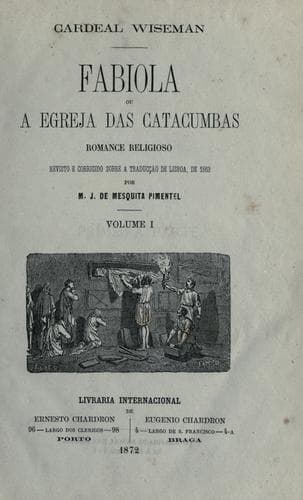
Fabiola; Or, The Church of the CatacombsWiseman, Nicholas Patrick
HistoryHistory
Fabiola; Or, The Church of the Catacombs
Wiseman, Nicholas Patrick
Christian fiction; Church history -- Primitive and early church, ca. 30-600 -- Fiction; Historical fiction
The morning broke light and frosty; and the sun, glittering on the
gilded ornaments of the temples and other public buildings, seemed to
array them in holiday splendor. And the people, too, soon came forth
into the streets in their gayest attire, decked out with unusual
richness. The various streams converge towards the Flavian amphitheatre,
now better known by the name of the Coliseum. Each one directs his steps
to the arch indicated by the number of his ticket, and thus the huge
monster keeps sucking in by degrees that stream of life, which soon
animates and enlivens its oval tiers over tiers of steps, till its
interior is tapestried all round with human faces, and its walls seem to
rock and wave to and fro, by the swaying of the living mass. And, after
this shall have been gorged with blood, and inflamed with fury, it will
melt once more, and rush out in a thick continuous flow through the many
avenues by which it entered, now bearing their fitting name of
_Vomitoria_; for never did a more polluted stream of the dregs and pests
of humanity issue from an unbecoming reservoir, through ill-assorted
channels, than the Roman mob, drunk with the blood of martyrs, gushing
forth from the pores of the splendid amphitheatre.
The emperor came to the games surrounded by his court, with all the
pomp and circumstance which befitted an imperial festival, keen as any
of his subjects to witness the cruel games, and to feed his eyes with a
feast of carnage. His throne was on the eastern side of the
amphitheatre, where a large space, called the _pulvinar_, was reserved,
and richly decorated for the imperial court.
[Illustration: The Coliseum.]
Various sports succeeded one another; and many a gladiator killed, or
wounded, had sprinkled the bright sand with blood, when the people,
eager for fiercer combats, began to call, or roar for the Christians and
the wild beasts. It is time, therefore, for us to think of our captives.
Before the citizens were astir, they had been removed from the prison to
a strong chamber called the _spoliatorium_, the press-room, where their
fetters and chains were removed. An attempt was made to dress them
gaudily as heathen priests and priestesses; but they resisted, urging
that as they had come spontaneously to the fight, it was unfair to make
them appear in a disguise which they abhorred. During the early part of
the day they remained thus together encouraging one another, and singing
the Divine praises, in spite of the shouts which drowned their voices
from time to time.
While they were thus engaged, Corvinus entered, and, with a look of
insolent triumph, thus accosted Pancratius:
“Thanks to the gods, the day is come which I have long desired. It has
been a tiresome and tough struggle between us who should fall uppermost.
I have won it.”
“How sayest thou, Corvinus? when and how have I contended with thee?”
Public-domain text, read in full here on John Shaqi.
Reviews
Reviews
No reviews yet
Be the first to share your thoughts on this work.
Elsewhere in the archive
Join the Discussion
Join the discussion
Sign in to leave a comment or review.
Sign InorCreate an account