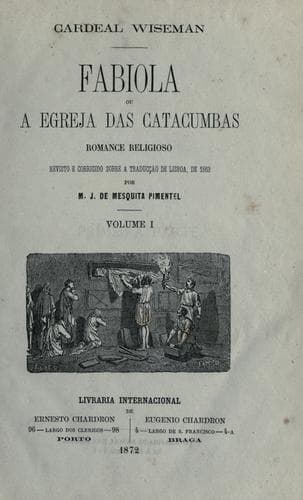
Fabiola; Or, The Church of the CatacombsWiseman, Nicholas Patrick
HistoryHistory
Fabiola; Or, The Church of the Catacombs
Wiseman, Nicholas Patrick
Christian fiction; Church history -- Primitive and early church, ca. 30-600 -- Fiction; Historical fiction
The persecution now increased its fury, and multiplied its daily
victims. Many whose names have appeared in our pages, especially the
community of Chromatius’s villa, rapidly fell. The first was Zoë, whose
dumbness Sebastian had cured. She was surprised by a heathen rabble
praying at St. Peter’s tomb, and was hurried to trial, and hung with her
head over a smoky fire, till she died. Her husband, with three others of
the same party, was taken, repeatedly tortured, and beheaded.
Tranquillinus, the father of Marcus and Marcellianus, jealous of Zoë’s
crown, prayed openly at St. Paul’s tomb; he was taken and summarily
stoned to death. His twin sons suffered also a cruel death. The
treachery of Torquatus, by his describing his former companions,
especially the gallant Tiburtius, who was now beheaded,[183] greatly
facilitated this wholesale destruction.
Sebastian moved in the midst of this slaughter, not like a builder who
saw his work destroyed by a tempest, nor a shepherd who beheld his flock
borne off by marauders. He felt as a general on the battle-field, who
looked only to the victory; counting every one as glorious who gave his
life in its purchase, and as ready to give his own should it prove to be
the required price. Every friend that fell before him was a bond less to
earth, and a link more to heaven; a care less below, a claim more above.
He sometimes sat lonely, or paused silently, on the spots where he had
conversed with Pancratius, recalling to mind the buoyant cheerfulness,
the graceful thoughts, and the unconscious virtue of the amiable and
comely youth. But he never felt as if they were more separated than when
he sent him on his expedition to Campania. He had redeemed his pledge to
him, and now it was soon to be his own turn. He knew it well; he felt
the grace of martyrdom swelling in his breast, and in tranquil certainty
he awaited its hour. His preparation was simple: whatever he had of
value he distributed to the poor, and he settled his property, by sale,
beyond the reach of confiscation.
Fulvius had picked up his fair share of Christian spoils; but, on the
whole, he had been disappointed. He had not been obliged to ask for
assistance from the emperor, whose presence he avoided; but he had put
nothing by; he was not getting rich. Every evening he had to bear the
reproachful and scornful interrogatory of Eurotas on the day’s success.
Now, however, he told his stern master--for such he had become--that he
was going to strike at higher game, the emperor’s favorite officer, who
must have made a large fortune in the service.
He had not long to wait for his opportunity. On the 9th of January a
court was held, attended, of course, by all aspirants for favors, or
fearers of imperial wrath. Fulvius was there, and, as usual, met with a
cold reception. But after bearing silently the muttered curses of the
royal brute, he boldly advanced, dropped on one knee, and thus addressed
him:
Public-domain text, read in full here on John Shaqi.
Reviews
Reviews
No reviews yet
Be the first to share your thoughts on this work.
Elsewhere in the archive
Join the Discussion
Join the discussion
Sign in to leave a comment or review.
Sign InorCreate an account