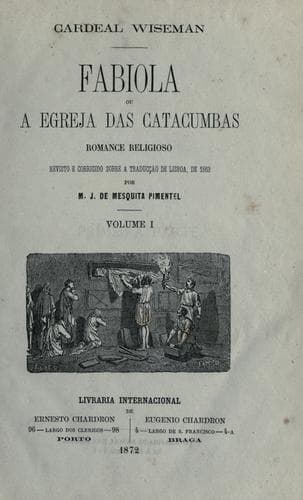
Fabiola; Or, The Church of the CatacombsWiseman, Nicholas Patrick
HistoryHistory
Fabiola; Or, The Church of the Catacombs
Wiseman, Nicholas Patrick
Christian fiction; Church history -- Primitive and early church, ca. 30-600 -- Fiction; Historical fiction
Fulvius had been gradually losing patience, and could no longer restrain
his passion. Rejected again, baffled once more by a child, this time
with the sword hanging over her neck! A flame irrepressible broke out
from the smouldering heat within him; and, in an instant, the venomous
ingredients that we have described as mingled in his heart, were
distilled into one black, solitary drop,--HATRED. With flashing look,
and furious gesture, he broke forth:
“Wretched woman, I give thee one more opportunity of rescuing thyself
from destruction. Which wilt thou have, life with me, or death?”
“Death even I will choose for her, rather than life with a monster like
thee!” exclaimed a voice just within the door.
“She shall have it,” he rejoined, clenching his fist, and darting a mad
look at the new speaker; “and thou too, if again thou darest to fling
thy baneful shadow across my path.”
Fabiola was alone for the last time with Agnes. She had been for some
minutes unobserved watching the contest, between what would have
appeared to her, had she been a Christian, an angel of light and a
spirit of darkness; and truly Agnes looked like the first, if human
creature ever did. In preparation for her coming festival of full
espousals to the Lamb, when she should sign her contract of everlasting
love, as He had done, in blood, she had thrown over the dark garments
of her mourning a white and spotless bridal robe. In the midst of that
dark prison, lighted by a solitary lamp, she looked radiant and almost
dazzling; while her tempter, wrapped up in his dark cloak, crouching
down to rush out of the low door of the dungeon, looked like a black and
vanquished demon, plunging into an abyss beneath.
Then Fabiola looked into her countenance, and thought she had never seen
it half so sweet. No trace of anger, of fear, of flurry, or agitation
was there; no paleness, no flush, no alternations of hectic excitement
and pallid depression. Her eyes beamed with more than their usual mild
intelligence; her smile was as placid and cheerful as it ever was, when
they discoursed together. Then there was a noble air about her, a
greatness of look and manner, which Fabiola would have compared to that
mien and stateliness, and that ambrosial atmosphere by which, in
poetical mythology, a being of a higher sphere was recognized on
earth.[199] It was not inspiration, for it was passionless; but it was
such expression and manner, as her highest conceptions of virtue and
intellect, combined in the soul, might be supposed to stamp upon the
outward form. Hence her feelings passed beyond love into a higher range;
they were more akin to reverence.
Agnes took one of her hands in each of her own, crossed them upon her
own calm bosom, and looking into her face with a gaze of blandest
earnestness, said:
“Fabiola, I have one dying request to make you. You have never refused
me any: I am sure you will not this.”
“Speak not thus to me, dearest Agnes; you must not request; you command
me now.”
Public-domain text, read in full here on John Shaqi.
Reviews
Reviews
No reviews yet
Be the first to share your thoughts on this work.
Elsewhere in the archive
Join the Discussion
Join the discussion
Sign in to leave a comment or review.
Sign InorCreate an account