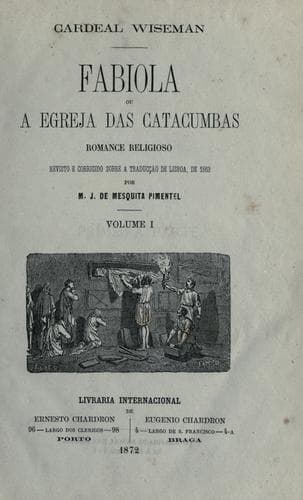
Fabiola; Or, The Church of the Catacombs — John Shaqi
Fabiola; Or, The Church of the CatacombsWiseman, Nicholas Patrick
HistoryHistory
Fabiola; Or, The Church of the Catacombs
Wiseman, Nicholas Patrick
Christian fiction; Church history -- Primitive and early church, ca. 30-600 -- Fiction; Historical fiction
But we must leave our nobler guests for more humble scenes, and follow
Syra from the time that she left her young mistress’s apartment. When
she presented herself to Euphrosyne, the good-natured nurse was shocked
at the cruel wound, and uttered an exclamation of pity. But immediately
recognizing in it the work of Fabiola, she was divided between two
contending feelings. “Poor thing!” she said, as she went on first
washing, then closing and dressing, the gash; “it is a dreadful cut!
What did you do to deserve it? How it must have hurt you, my poor girl!
But how wicked you must have been to bring it upon yourself! It is a
savage wound, yet inflicted by the gentlest of creatures! (You must be
faint from loss of blood; take this cordial to support you): and no
doubt she found herself obliged to strike.”
“No doubt,” said Syra, amused, “it was all my fault; I had no business
to argue with my mistress.”
“_Argue_ with her!--argue!--O ye gods! who ever heard before of a slave
arguing with a noble mistress, and such a learned one! Why, Calpurnius
himself would be afraid of disputing with her. No wonder, indeed, she
was so--so agitated as not to know that she was hurting you. But this
must be concealed; it must not be known that you have been so wrong.
Have you no scarf or nice veil that we could throw round the arm, as if
for ornament? All the others I know have plenty, given or bought; but
you never seem to care for these pretty things. Let us look.”
She went into the maid-slave’s dormitory, which was within her room,
opened Syra’s _capsa_ or box, and after turning over in vain its scanty
contents, she drew forth from the bottom a square kerchief of richest
stuff, magnificently embroidered, and even adorned with pearls. Syra
blushed deeply, and entreated not to be obliged to wear this most
disproportioned piece of dress, especially as it was a token of better
days, long and painfully preserved. But Euphrosyne, anxious to hide her
mistress’s fault, was inexorable; and the rich scarf was gracefully
fastened round the wounded arm.
This operation performed, Syra proceeded to the little parlor opposite
the porter’s room, where the higher slaves could see their friends. She
held in her hand a basket covered with a napkin. The moment she entered
the door a light step came bounding across the room to meet her. It was
that of a girl of about sixteen or seventeen, dressed in the poorest
attire, but clean and neat, who threw her arms round Syra’s neck with
such a bright countenance and such hearty glee, that a bystander would
hardly have supposed that her sightless eyes had never communed with the
outer world.
“Sit down, dear Cæcilia,” said Syra, with a most affectionate tone, and
leading her to a seat; “to-day I have brought you a famous feast; you
will fare sumptuously.”
“How so? I think I do every day.”
“No, but to-day my mistress has kindly sent me out a dainty dish from
her table, and I have brought it here for you.”
Public-domain text, read in full here on John Shaqi.
Reviews
Reviews
No reviews yet
Be the first to share your thoughts on this work.
Join the Discussion
Join the discussion
Sign in to leave a comment or review.
Sign InorCreate an account